12 of the 13 district judges in Dallas County have joined this order that implements recent changes to the TRCP about summary-judgment practice:
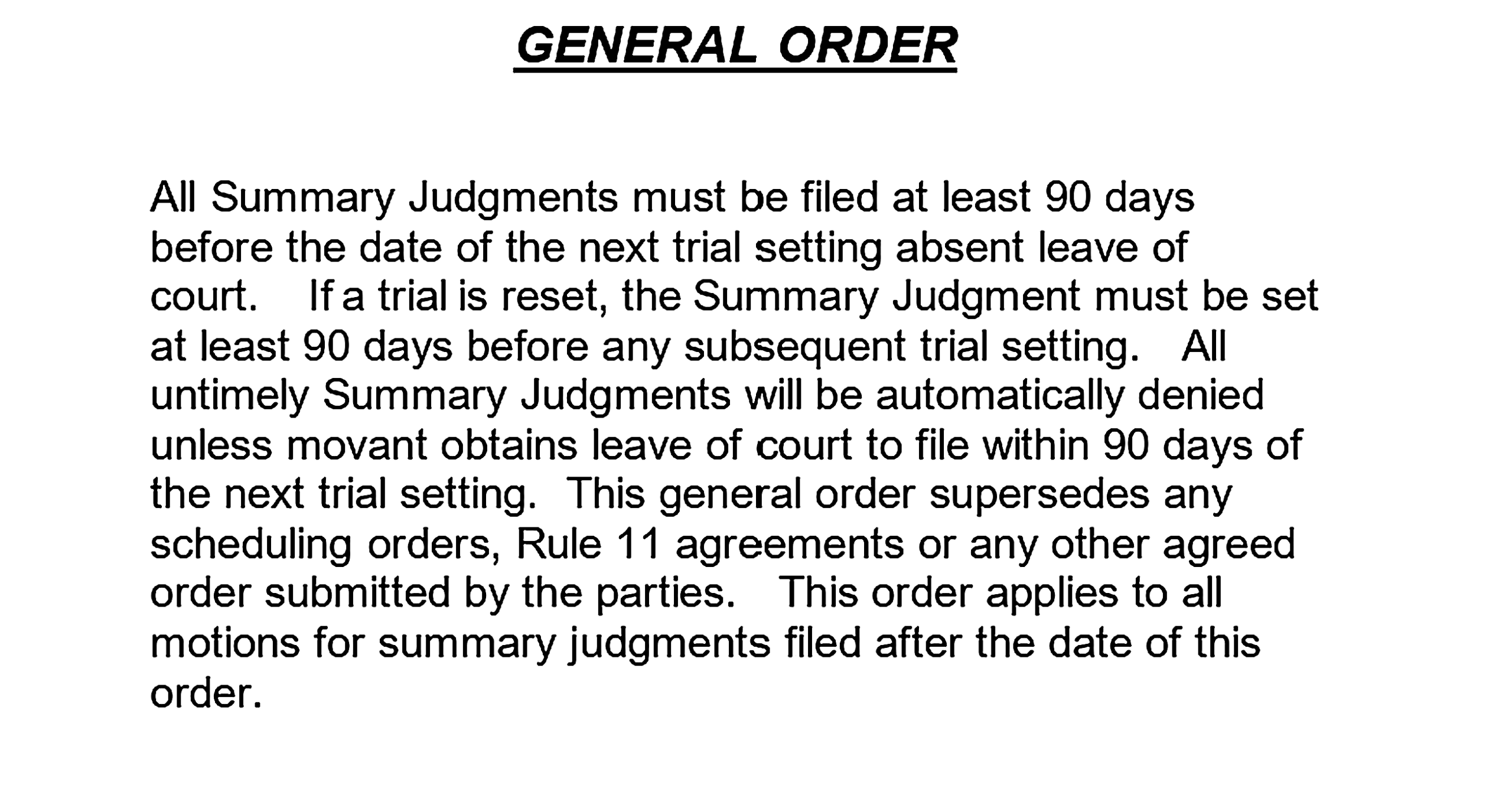
12 of the 13 district judges in Dallas County have joined this order that implements recent changes to the TRCP about summary-judgment practice:
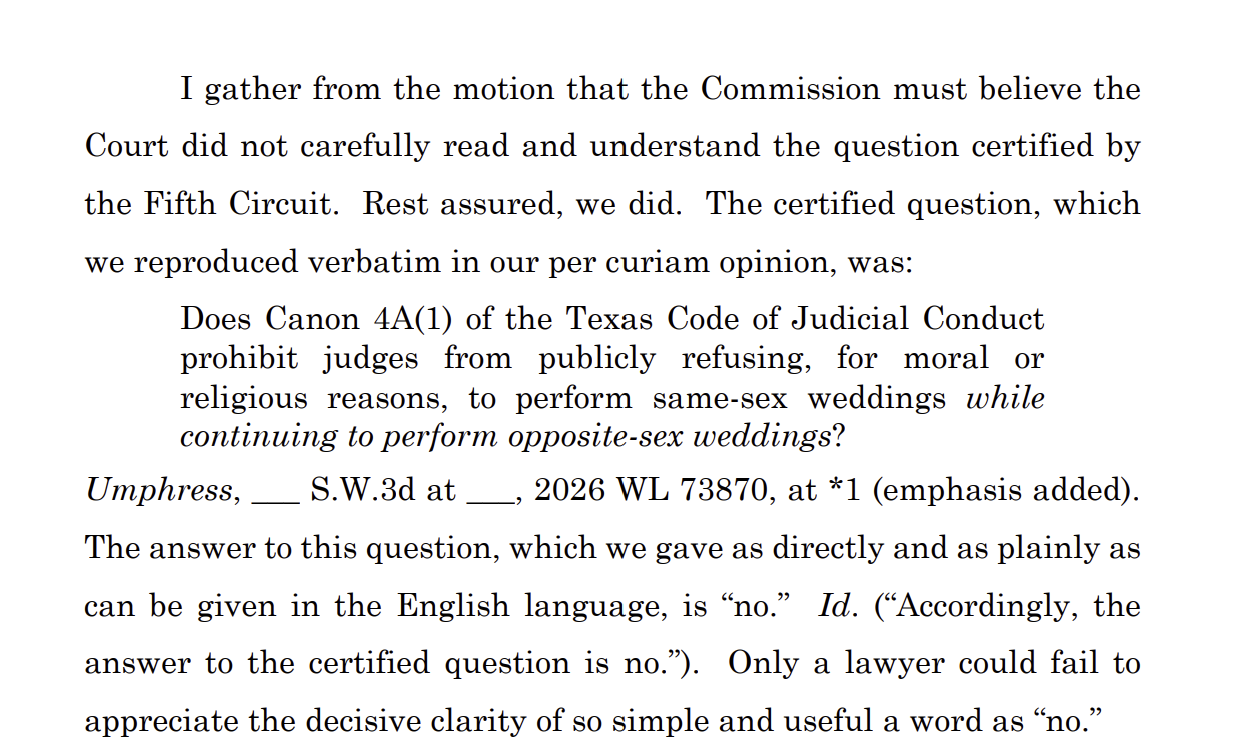
The Chief Justice’s recent concurrence in the denial of rehearing in Umphress v. Steel (a certified question from the Fifth Circuit about judicial conduct) emphasized the elegance of the word “no”:
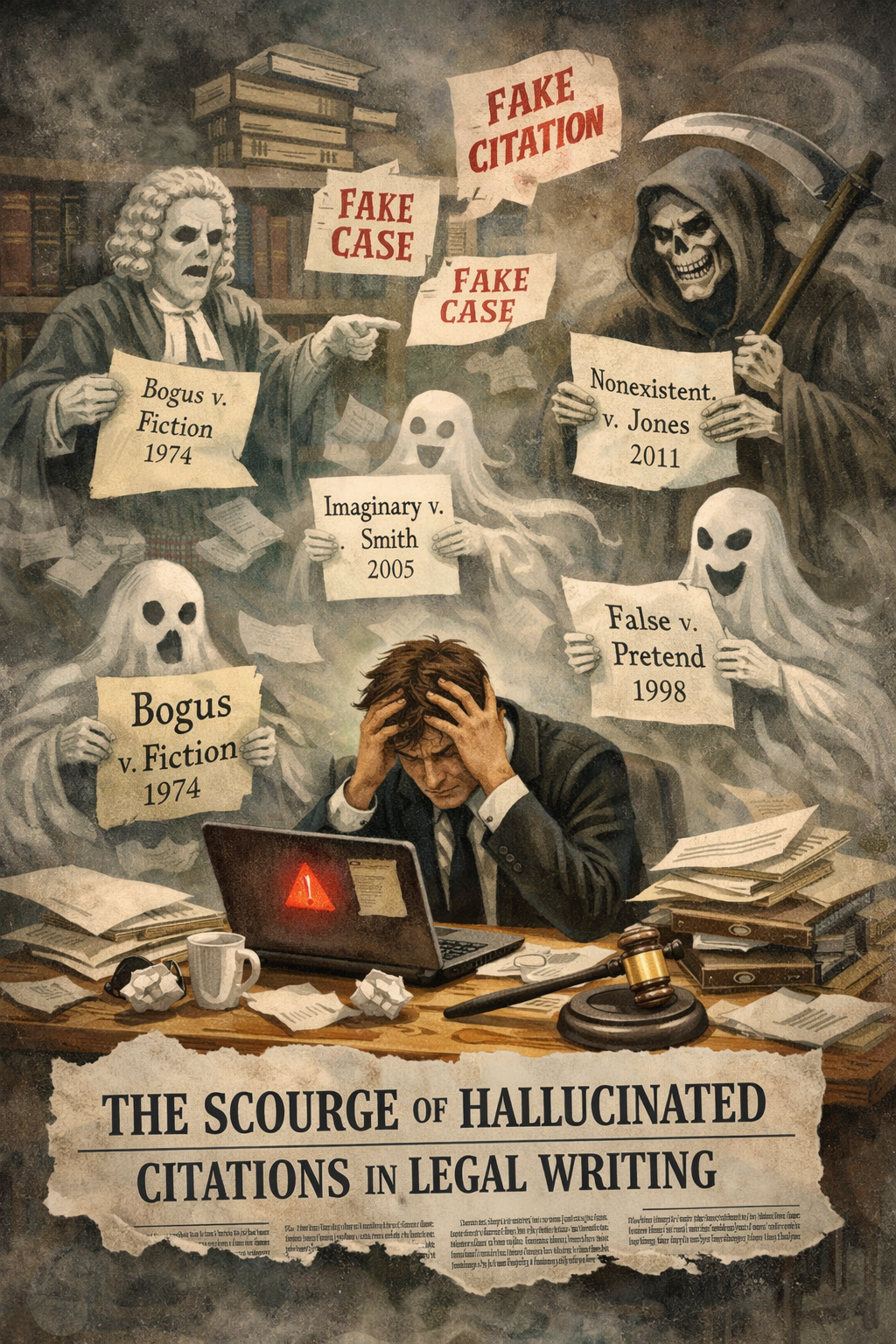 There have been two recent opinions about generative AI that you should know about
My friend Art Ayala recently visited the Texas Appellate Law Podcast to discuss the complexities of securing supersedeas bonds when a client faces an adverse verdict. Key topics include:
• Timing: Why counsel should consider advising clients to initiate the bonding conversation even before a judgment is entered.
• Process: How process typically flows from the initial call with a client to bond issuance.
• Collateral Options: Pros and cons of various collateral options.
You can listen to the full conversation here: Supersedeas Bonds in the Real World.
 In Burnett v. Aguilar Lozano, the Fifth Court of Appeals at Dallas addressed whether various evidentiary objections to summary judgment evidence are defects of form or substance-a distinction that matters because “deficiencies in form cannot be considered when there was no objection in the trial court,” while “substantive deficiencies pertain to the sufficiency of the evidence and can therefore be challenged and considered for the first time on appeal.”
These are objections to form:
These are substantive defects:
While parts of the nonmovant’s affidavit were conclusory and thus substantively deficient, the unauthenticated accident report was properly before the court due to the absence of objection, and raised a genuine fact issue on breach of duty. No. 05-24-01503-CV (Tex. App.-Dallas Feb. 12, 2026).
 In The Pink Panther Strikes Again, Inspector Clouseau famously asks: “Does your dog bite?” So too, the Fifth Court of Appeals, in Latcher v. Edwards, which rejected a negligence claim against a dog owner
Specifically, the Court held that the evidence of foreseeability was legally insufficient where the dog had never escaped from its enclosed backyard before, the owner did not know the side gate had been opened, and the dog had no history of startling, jumping on, or injuring anyone. Rejecting the plaintiff’s argument that the dog had been “roaming the neighborhood for a week” before the incident, the court found the evidence only showed the dog was at a shelter or with a shelter volunteer—not loose on the streets—during the week it took the owner to retrieve him. No. 05-24-01259-CV (Feb. 11, 2026)
In a fraudulent-lien case, the Fifth Court distinguished between different types of intent:
EarnhartBuilt also makes a brief argument that the nearly three-month delay in removing the lien from the Property after Preferred received the October 13, 2022 email created a genuine issue of material fact as to whether Preferred had knowledge that the lien was fraudulent when filed.
EarnhartBuilt relies heavily on authority, emphasizing that “intent is a fact question uniquely within the realm of the trier of fact because it so depends upon the
credibility of the witnesses and the weight to be given to their testimony.” Although intent may be inferred from a party’s subsequent acts, any inferences concerning Preferred’s intent from its three-month delay in releasing the lien, at most, relate to element 3 (an intent to cause financial injury) and not to element 1 (what Preferred knew at the time it filed the lien).
Earnhardbuilt LLC v. Preferred Materials, LLC, No. 05-24-00804-CV, Feb. 5, 2026 (citations omitted).
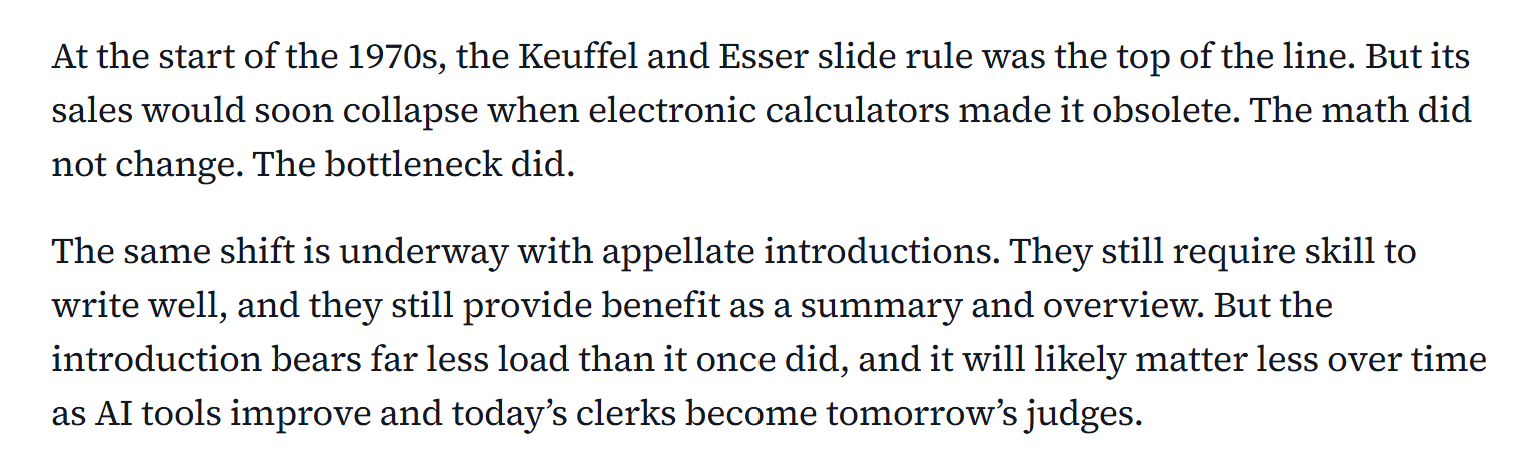
I recently published a short comment on the new Texas Rule of Appellate Procedure requiring a substantive introduction to petitions for review, in which I question the value of introductions in a time when generative AI can review and summarize the most complex of briefs in a few seconds.
 The Fifth Court granted mandamus relief in In re Pillar Income Asset Management, holding that a new-trial order based on “incurable” improper argument was an abuse of discretion because the challenged remarks—though often improper—were not so extreme or inflammatory that an instruction could not cure any harm.
On this record, and under the demanding substantive standard, the Court concluded that personal barbs at opposing counsel, aggressive treatment of an expert, references outside the record, statements of personal opinion, and brief appeals to local or religious identity were improper but curable, and therefore could not support a new trial without timely objections and requested curative instructions.
Distinguishing the Fifth Circuit’s recent Clapper decision that reversed because of improper argument, the Court underscored that Texas requires proof that the challenged rhetoric was “so extreme that a juror of ordinary intelligence could have been persuaded by that argument to agree to a verdict contrary to that to which he would have agreed but for such argument.” The Court summarized: “Incurable argument is rare.” 05-25-00205-CV; Jan. 14, 2026.
 A homeowners’ association, sued for over-enforcement of parking rules, argued that the plaintiffs lacked standing because they were tenants and did not own property in the relevant association area. The Fifth Court agreed:
[W]e conclude the Declaration [of the HOA] contemplates affecting the rights, status, or other legal relations of occupants other than property owners. Moreover, the resident appellees’ petitions, original and amended, assert that the Lutzes were charged legal fees by the company that owns the house they lease and that the same company warned the Lutzes that the lease would be voided for future parking violations. Therefore, we conclude the Lutzes asserted and provided evidence that their rights, status, and other legal relations are affected by the Declaration such that they may seek a declaration of their rights, status, and other legal relations under the Declaration.
Shores at Lake Ray Hubbard Owners Association v. Lutz, No. 05-24-00717-CV (Jan. 21, 2026).
 The Washington Post offers this lighthearted but substantive quiz to help you identify your perfect font. Give it a try!
 In re Cedar Hill Hotel LLC clarifies the applicability of Section 15.0642 of the Texas Civil Practice and Remedies Code, which addresses mandamus petitions to enforce mandatory-venue provisions.
The Court emphasized that Section 15.0642’s deadlines are keyed to “the date the trial starts” or “notice of the trial setting,” but once a transfer order issues, any prior trial setting in the transferring court becomes a nullity and no trial will “start” there. Therefore: “Section 15.0642 of the Texas Civil Practice and Remedies Code does not apply when a party seeks a writ of mandamus to compel a respondent judge to vacate an order granting a motion to transfer venue and transferring an entire action to another county.”
In this action, because the relator sought mandamus after the 30-day plenary period, the proceeding was moot and the appellate court lacked jurisdiction. No. 05-24-01478-CV; Dec. 23, 2025
 A recent dispute about various statistical-reporting requirements for prosecutors led to a lively summary of the law in Texas about appellate stays.
 Steinhagen v. MC Trilogy Texas LLC makes two key points about the Texas Citizens Participation Act: first, that commentary alleging municipal corruption in publicly accessible YouTube broadcasts addresses matters of public concern and thus triggers the TCPA framework; second, that the discovery rule does not extend limitations for defamation or business disparagement arising from such public posts.
On the limitations issue, the Court emphasized that reputational injuries from mass‑media publications are not “inherently undiscoverable,” analogizing YouTube dissemination to newspapers or television for accrual purposes.
As for another stream, the Court held the plaintiff failed to make a prima facie showing because the statement that a “public record” had “disappeared” did not specifically refer to the plaintiff, and the remainder—predicting that speaking to authorities would put one’s “life … in jeopardy”—was a nonactionable opinion about future events, not a verifiable fact. No. 05-24-00325-CV; Dec. 29, 2025. Notably, this is a fairly uncommon “opinion” from the Fifth Court, rather than a “memorandum opinion.”
 The Fifth Court reversed a judgment about an alleged violation of a restrictive covenant by a “tiny house” when:
The Morrisseys’ original petition was their live pleading at the time the trial court granted their motion for summary judgment. Despite the recitations in the trial court’s judgment, the Morrisseys’ original petition failed to allege the Czegledis violated a restrictive covenant concerning square footage. Finally, the Czegledis timely argued that it would be unjust to grant summary judgment based on an unpled allegation; thus, the parties did not try the Morrisseys’ allegation concerning minimum square footage by consent. Therefore, our de novo review reveals the trial court’s summary judgment is void because it is not supported by the Morrisseys’ live pleading.
Czegledi v. Morrissey, No. 05-24-00739-CV (Dec. 15, 2025) (citations omitted).
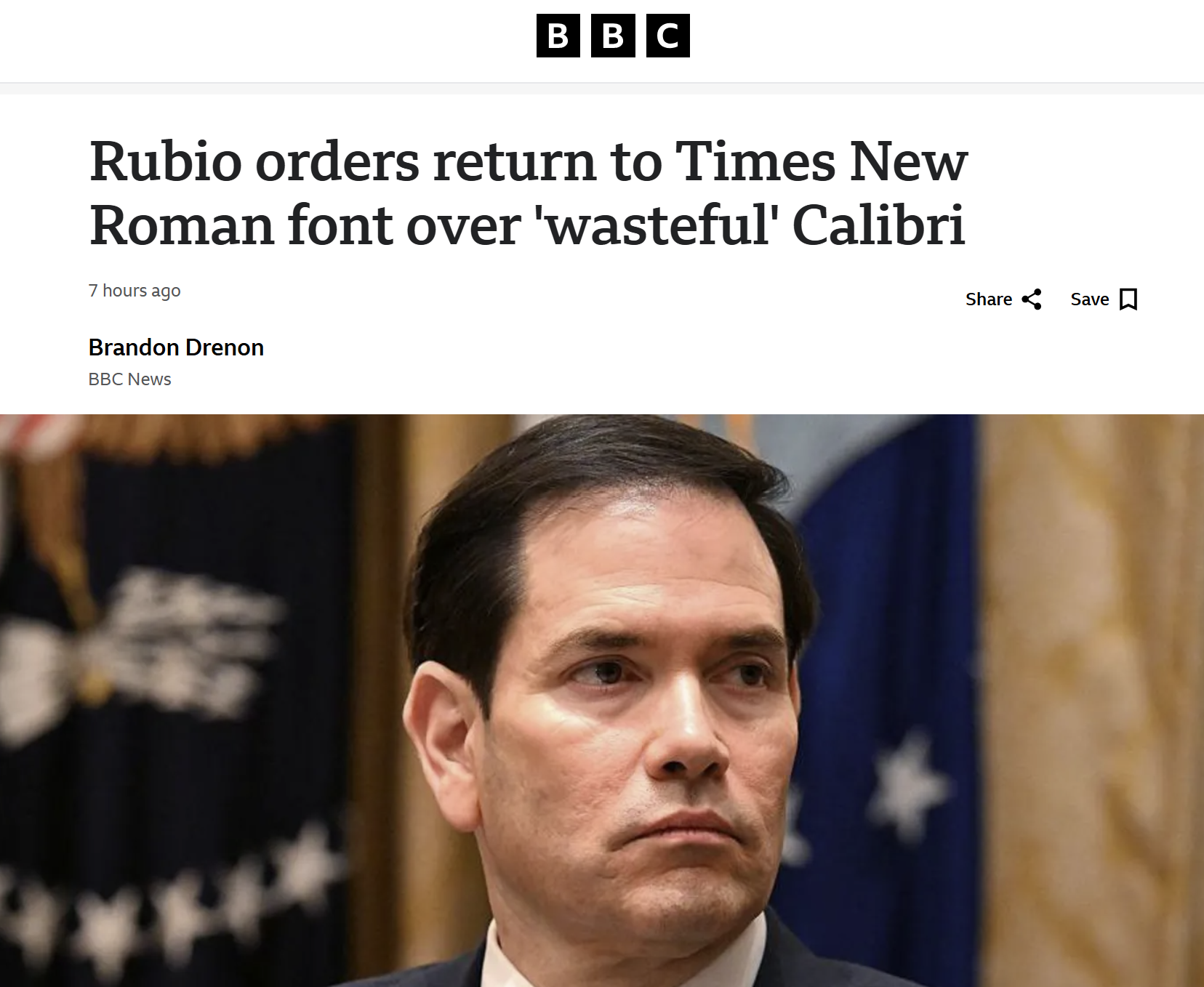
Font selection has global consequences, as the State Department returns to Calibri from Times New Roman (imho, the State Department should jettison both fonts and use a tasteful modern serif font, such as Equity or Book Antigua).
The Fifth Court reversed the grant of a Rule 91a motion to dismiss in Skibell v. Fobare, reminding: “When considering pleading sufficiency, the Supreme Court of Texas has repeatedly concluded that a pleading provided fair notice of a claim despite it not including the specific name for that claim,” and citing these two paragraphs from the plaintiffs’ 10-paragraph petition:

No. 05-24-00723 (Dec.8, 2025) (mem. op.).
The Texas Supreme Court recently reminded that, in addition to the 3-factor Craddock test for when a new trial is required after a default judgment, the “ordinary” motion for new trial is also available as an option:
“Even if a defendant does not satisfy the Craddock test, a trial court has broad discretion to determine that another ground identified in the defendant’s motion constitutes ‘good cause’ to order a new trial following a default judgment. See TEX. R. CIV. P. 320. This is so because such judgments are disfavored and “differ from every other kind in a fundamental way.” In re Lakeside Resort JV, LLC, 689 S.W.3d 916, 920 (Tex. 2024).”
Tabakman v. Tabakman, No. 24-0919 (Tex. Dec. 5, 2025).
On the criminal-law side of the docket, a baffling situation about the number of empaneled jurors led to reversal of a conviction in Leal v. State because “The record matters”:
At oral argument, the absurdity of this scenario was discussed with both counsel for the state and counsel for the appellant. It defies logic that neither the trial judge, nor the bailiff, nor the court reporter, nor either party noticed throughout the entire trial that the jury box was missing a twelfth juror. Yet, the record demonstrates exactly that. A reasonable assumption is that there must have been twelve jurors. But the State attempted to supplement the record to show the presence of and identity of a twelfth juror. The supplementation was unsuccessful in providing this proof.
No. 05-24-00446-CR (Nov. 19, 2025).
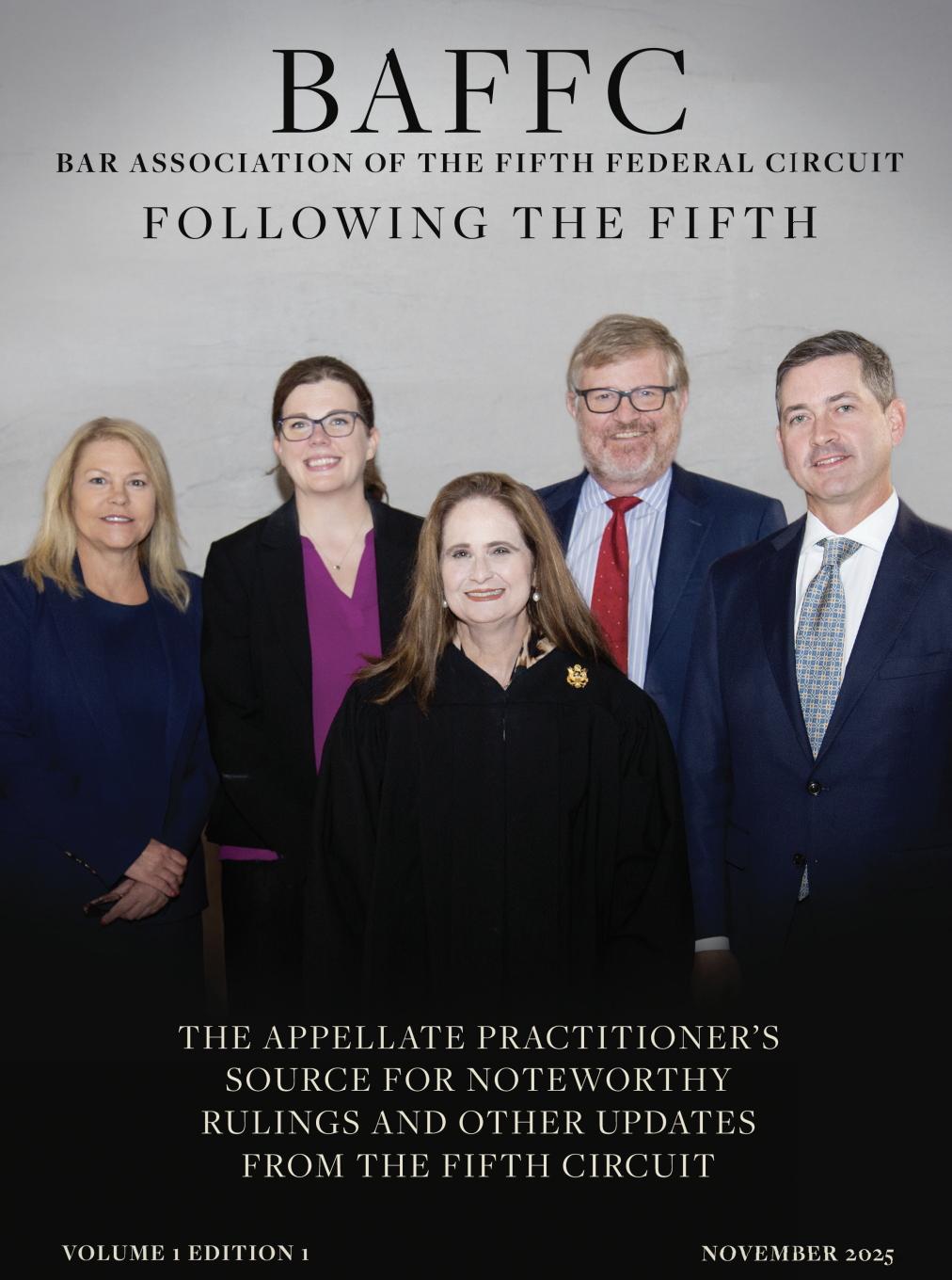 (This is a cross-post from 600Camp) If you aren’t yet a member of the Bar Association of the Fifth Federal Circuit (or “BAFFC” to those in the know) you should join! Our gifted new executive director, Donna Cuneo, led the charge for this awesome new publication, “Following the Fifth” that has general news and also highlights the great work of Krystil Lawton and Walter Woodruff — here is the first edition!
 The Texas Supreme Court addressed the important topic of expert testimony about legal issues in In re Lopez. It held that the trial court improperly admitted a former judge’s expert testimony on whether an informal marriage existed because (1) the issue was within the common knowledge of jurors and (2) the witness offered legal opinions and judicial imprimatur (she was a former judge) rather than helpful expertise.
The Court emphasized that the expert repeatedly told the jury how she would rule “wearing [her] judge’s hat,” opined on a legal presumption, and thereby provided “an official endorsement” of one side’s position—testimony Rule 702 does not permit. The Court concluded the error was harmful and ordered a new trial. No. 24-0315 (Tex. Nov. 7, 2025).
Fofanah v. Rockwall Rental Properties clarifies some basic principles about JP court jursdiction over FED actions. The basic rule, of course, is that the JP court has jurisdiction unless there is a dispute about title. These principles, in turn, help define whether a title dispute has been presented:
No. 05-24-01265-CV (Nov. 7, 2025).
 The Fifteenth Court’s recent opinion in State of Texas v. Yelp is a good summary of Texas personal-jurisdiction law about online activity.
Texas sued Yelp under the DTPA, alleging that Yelp appended a “Consumer Notice” to the business pages of crisis pregnancy centers, including more than 200 in Texas, that misled Texas consumers. Yelp specially appeared.
The Court found that Texas did not adequately plead general jurisdiction. Raising a theory of “consent by registration” in response to the special appearance did not qualify as raising the issue in a pleading, as required in this procedural context.
While the Court did not reach the issue, it showed skepticism toward reading Texas’s registration statutes as conferring consent to general jurisdiction.
Texas did establish specific jurisdiction, concluding that:
No. 15-24-00040-CV (Oct. 16, 2025).
Contempt was inappropriate in the following situation:
“[T]he trial judge found ‘that certain terms of the divorce decree are not specific enough to be enforced by contempt and should be clarified.’ He then clarified the order to include the specific date, time, and address for Le to comply with the payment obligation. Despite correctly finding that the provision lacked sufficient clarity to be enforced by contempt, the trial judge nevertheless found Le in contempt of that same provision without providing adequate notice or a reasonable time for him to comply with the clarified order. Because Le did not have notice or a reasonable time to comply with the Clarification Order, the trial court’s finding that he acted with ‘willful disobedience to or disrespect of a court by acting in opposition to its authority’ was arbitrary, unreasonable, and without reference to any guiding rules or principles.”
In re Le, No. 05-25-00019-CV (Oct. 29, 2025).
 Credit Suisse AG v. Claymore Holdings, on a second appeal about interest after an earlier appeal on the merits, affirmed the Fifth Court’s commitment to stare decisis:
Horizontal stare decisis addresses the respect that a court owes its own precedents. See Mitschke v. Borromeo, 645 S.W.3d 251, 256 (Tex. 2022). A three-judge panel must follow the decisions of earlier panels of the same court unless a higher authority has superseded it. Id. Horizontal stare decisis is nothing more than a manifestation of our commitment to precedent. Id. If this panel overruled the previous panel, there would be nothing that would stop a third panel from overruling this panel. See id. The result would not be order and stability but chaos and unpredictability.
No. 05-24-01124-CV (Oct. 21, 2025) (mem. op.).
My friend Arturo Ayala recently forwarded me yet another interesting article by his agency about the market for supersedeas bonds, “Appeal Bonds in a World of Nuclear Verdicts and Higher Interest Rates.” Worth a look!
 Megatel Homes v, Martin, in the context of a dispute about arbitration of a contract to build a home, provides a succinct explanation of contract formation and its legal significance:
The parties’ conduct objectively manifested an agreement on the subject matter and the essential terms of the contract—Megatel would build a house at a specific address for the Martins in exchange for the Sales Price. Thus, we conclude that the parties entered into a contract that defined their respective rights. Both the June Document and July Document include the same arbitration clause that Megatel seeks to enforce, and to which the parties agreed. … Although the Martins maintain that they would not have entered into the contract if they had known about the alleged misrepresentations made by Megatel, those complaints go to the merits of the lawsuit rather than whether a contract was formed. The terms of that contract, based on the undisputed conduct of the parties, necessarily include the arbitration provision even though it may not include the list of Special Features—a matter we do not reach today.
No. 05-25-00030-CV (Oct. 24, 2025) (emphasis added).
 Stein v. Beneficient, again, confirmed an arbitration award under the deferential standard in Texas law. The Fifth Court reminded that an award must be confirmed unless a statutory ground for vacatur or modification is established, and that even a legal or factual mistake by the arbitrator does not justify overturning the result so long as the arbitrator was at least arguably construing the contract.
In particular, the Court held that the arbitrator’s damages methodology, which relied on the respondent’s SEC filings and internal valuations to assess the value of the equity interests at the time of breach, reflected contract-based reasoning rather than impermissible equitable relief. The court rejected challenges about interest calculation, general methodology, and evidentiary rulings for similar reasons. No. 05-24-00914-CV; Oct. 10, 2025.
 MUSA Auto Holdings, LLC v. Frunzi illustrates Texas’s narrow judicial review of arbitration awards when a party claims the arbitrator exceeded his powers.
The Fifth Court emphasized that the question is whether the arbitrator was empowered by the parties’ agreement to decide the issue, and whether the award is rationally connected to that agreement. Under that standard, “even a mistake of fact or law by the arbitrator in the application of substantive law is not a proper ground for vacating an award.”
Applying that standard, the Court held the arbitrator acted within his authority by interpreting and applying the employment agreement’s specific “for Cause” definition—including its “willful” component—to the evidence, rather than imposing an extra-contractual standard.
The appellant’s main argument—that the arbitrator “rewrote” the agreement by requiring proof of scienter and by questioning whether the stated grounds were the “true reason” for the termination—failed because the arbitrator’s analysis was rooted in the contract’s text and was thus “rationally inferable from the parties’ agreement.” No. 05-24-00184-CV; Oct. 1, 2025.
In re Hefflefinger Partnership holds that a trial court, presiding over a post-judgment turnover proceeding, cannot adjudicate the substantive rights of a non-party by declaring a deed of trust void and reallocating sale proceeds. Specifically, the Fifth Court held that the turnover statute is a procedural collection device and does not authorize courts to resolve competing claims to property, or proceeds within the turnover action itself.
Because the statute “has no provision conferring authority on trial courts to decide the substantive rights of the parties properly before it in a turnover proceeding, let alone the rights of strangers to the underlying judgment,” the court held the trial court abused its discretion by voiding the lien and denying the lienholder any share of sale proceeds.
Mandamus relief was appropriate because the affected lienholder—who was not a party to the underlying judgment—lacked an adequate remedy by appeal. No 05-23-01091-CV, Oct. 2, 2025.
 In Guillaume v. EKRE of Texas, an FE&D appeal, the appellant argued that the appeal became moot after the appellee conveyed the relevant property. The Fifth Court disagreed, accepting the appellee’s two counterarguments:
“First, EKRE relies on the “well-settled rule” that if the interest of either party is purchased by a third party after the suit has commenced, the purchaser stands in the shoes of the seller, the sale does not moot the case, and “[t]he lawsuit may be continued in the name of the seller, or the court may exercise its discretion to allow the purchaser to be substituted in as a party in place of the seller.”” (citation omitted).
“Second, EKRE contends that, regardless of this well-settled rule, the third-party purchaser leased the property back to EKRE and it therefore retains “its rights in the property as landlord.” No. 05-24-00316-CV (Sept. 17, 2025).
 In Ovation Services v. Buckner Foods, the Fifth Court addressed basic issues in the business of tax loans, as follows:
Finally, the court declared the tax liens superior to any other interest in the property and enforceable by the lender, confirming the lender’s right to recover all amounts due under the property tax loan agreement and to pursue judicial foreclosure. No. 05-24-00496-CV, Sep. 11, 2025
 In Dartex Holdings Corp. v. Royalty Lending II, Ltd., the Dallas Court of Appeals held that an affidavit filed to domesticate a foreign judgment under the UEFJA was facially deficient because it did not show the affiant’s personal knowledge. The attorney who signed the affidavit merely identified her role, recited addresses, and summarized the judgment without stating any basis for knowing those facts. The Court thus reversed and rendered, denying domestication, while allowing a compliant refiling. No. 05-24-00984-CV, Sept. 15, 2025
 In Melton v. Randall Management, the Fifth Court reversed a summary judgment on a conversion claim, concluding that a property manager’s post-eviction conduct could constitute an unlawful exercise of dominion over the tenant’s belongings.
The Court emphasized that the relevant writ of possession only authorized officers to place the tenant’s property “outside the rental unit at a nearby location” or, at the officer’s discretion, to engage a warehouseman to store it. As the Court summarized, the manager “has not shown, and we have not found, that affirmatively removing and disposing of the evicted tenant’s personal property is one of [those] authorized” options.
Because the manager admitted it ultimately “removed the remaining debris … and disposed of it,” the appellate court held that fact issues existed on whether the disposal was wrongful, making summary judgment improper.The panel also rejected the manager’s effort to rely on the eviction writ as a blanket defense, distinguishing the lawful execution of the writ from the later, independent decision to discard the tenant’s property.No. 05-23-01315-CV, Sept. 8, 2025
 The defendant in Western Securities, Ltd. v. Jaffer filed a special appearance, supported by a declaration. The trial court denied the special appearance.
The plaintiff did not object to the procedural adequacy of the special appearance, in the trial court or on appeal.
Although there was no party presentation of the issue, the Fifth Court reversed, citing its precedent that this special appearance was “unsworn” because the declaration and special appearance were not identical in substance, and thus did not comply with Tex. R. Civ. P. 120a:
Brescia’s declaration did not attest to all the facts alleged in the special appearance—only those stated in his declaration. His declaration did not say he had read the special appearance. It never even mentioned the special appearance. In fact, it was dated about one month before the special appearance was filed. Moreover, based on our review of the special appearance and the declaration, it is apparent that the special appearance set out several jurisdictional allegations that Brescia did not attest to in his declaration.
No. 05-24-01492-CV (Sept. 5, 2025).
 In Polaris Elec. Co. v. Raspberry 353 LLC, the Fifth Court held that a Taiwanese electronics manufacturer lacked sufficient jurisdictional contacts with Texas.
The company did not maintain offices, employees, or advertising in the state, and its only Texas-bound products reached the forum solely because a third-party customer directed shipment “FOB Taiwan.” Allegations that the defendant conspired to hinder collection of a Texas judgment and engaged in fraudulent transfers were not enough; the court concluded those acts occurred abroad and therefore could not supply the necessary “Texas activities.”
Rejecting stream-of-commerce arguments, the court emphasized that mere awareness a product may end up in Texas does not equate to purposeful availment when title and control pass overseas. As a result, a $30+ million default judgment was vacated and the substantive claims dismissed. No. 05-23-00382-CV; Aug. 29, 2025
A recent concurrence from the denial of a mandamus petition provided a reminder about the precedential value of a denial: “[T]his Court’s failure to grant a petition for writ of mandamus is not an adjudication of, nor even a comment on, the merits of a case in any respect, including whether mandamus relief was available.” (quoting In re AIU Ins. Co., 148 S.W.3d 109, 119 (Tex. 2004)).
 The legend of “Bonnie and Clyde” continues with In re Matter of Parker. A distant relative of Bonnie Parker obtained an order requiring the disinterment of her remains and their reburial by Clyde Barrow’s resting place. (I did not have this dispute on my “bingo card” for 2025.)
The cemetery association appealed and sought to supersede the disinterment order, with the persuasive argument that “[l]eaving the obligations of the parties where they are and the remains of Mrs. Parker where they have been since 1945 perfectly preserves the status quo ….”
As to the law governing this unusual dispute, the Fifth Court held that an appellant subjected to a mandatory injunction is “entitled to supersede a non-monetary judgment” under Tex. R. App. P. 24.1(a). Because the disinterment of human remains is, definitionally, a one-time act that would moot any appellate review, the Court reversed the trial court’s refusal to set security,. TheCourt then fixed the amount of security at zero, noting the appellee’s failure to articulate any compensable harm from a stay, and Mrs. Parker’s lengthy and uninterrupted presence in the cemetery. No. 05-24-00809-CV (Aug. 27, 2025).
The Fischer case discussed last week also addressed fiduciary duties in the context of closely held corporations and post-divorce disputes.
The Court held that, under Texas law, officers and directors of a corporation owe fiduciary duties to the company itself, not to individual shareholders—even when those shareholders are former spouses.
The Court also rejected the argument that a marital relationship or the existence of a divorce decree could create or extend fiduciary duties between former spouses in their capacity as business co-owners. Once divorce proceedings are initiated, any fiduciary duty arising from the marriage itself is extinguished.
Accordingly, there was no evidence to support the existence of a fiduciary relationship between the parties beyond the formal duties owed to the company. No. 05-23-00679-CV, Aug. 14 2025.
 The Fifth Court received these facts in Yancey v. SLJ Co.:
The parties received the Court’s conclusion that this order was an abuse of discretion:
The record reveals no “great emergency or imperative necessity” requiring the appointment of a new receiver to replace the deceased receiver without notice or a hearing. n the contrary, the record suggests that no actions were taken with respect to the receivership between April 2021 and December 2023. The transcript of the January 2021 hearing on the first motion to appoint a receiver is in the record, but none of the squabbling over Yancey’s assets contained therein sheds light on her financial affairs nearly three years later in December 2023. Yet the trial court’s order, without notice or a hearing, provided the new receiver with comprehensive powers to assume Yancey’s property was not exempt; enter any real property or other premises where non-exempt property or Yancey’s records might be situated; and “employ reasonable destructive means to bypass or gain access to” non-exempt assets within any real property.
No. 05-23-01285-CV (Aug. 21, 2025) (mem. op.) (citations omitted).
My capable friend Arturo Ayala of Court Surety Bond Agency recently wrote this helpful short article, “Texas Rule Changes Securing Supersedeas Bonds on Appeal.”
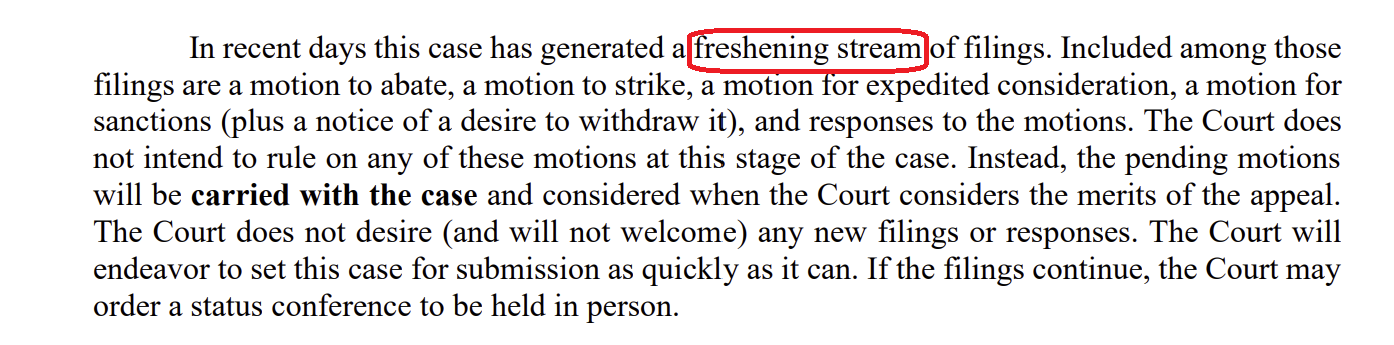
Hon David Gunn of Houston’s First Court of Appeals has given new life to the word “freshening” as an adjective for a frustrating series of court filings (thanks to Ben Taylor for drawing my attention to it):
 In Fischer v. Fischer, the FifthCourt applied judicial estoppel to bar an ex-spouse’s post-divorce tort and fiduciary-duty claims.
During the divorce, she argued—and the family court accepted—that a post-marital “Agreement to Convert” stock into community property was “valid and legally enforceable.” After obtaining half of the company shares on that basis, she sued her former husband alleging misconduct tied to those same shares.
The Court noted that judicial estoppel turns on three factors: the party’s prior inconsistent position, success with that position, and the deliberate, unequivocal nature of the original stance. All three were satisfied: by embracing the Agreement to Convert, she “benefited from the divorce court’s acceptance of her position,” namely, a community-property award worth half the company. The Court concluded that her subsequent lawsuit was foreclosed because “all of [her] claims…are claims against converted property,” a position at odds with the estoppel she promised in the Agreement itself. No.05-23-00679-CV, Aug. 14, 2025.
 No consideration existed when a purported settlement agremeent “simply stated that Al Jundi owed Plaintiff $224,500 and provided a payment schedule. The agreement contained no mutuality of obligation or bargained for exchange of promises. Plaintiff made no promises under the settlement agreement. It imposed no obligations on him. There was no detriment to him. He stood only to benefit from an additional recourse for recovery of his money. Al Jundi, in promising to pay a debt he did not personally owe, received no benefit.” Al Jundi v. Eljindi, No. 05-23-01121-CV (Aug. 11, 2025).
 In Lindberg v. Roskind, the Fifth Court considered – and rejected – the plainitff’s argument that the defendant orchestrated a complex corporate scheme involving Texas-based entities. The Court found no evidence that the defendant himself had any direct contacts with Texas, such as conducting business, maintaining offices, or exercising control over the relevant entities from within the state. The defendant’s uncontroverted declaration established that he was a Florida resident, had not visited Texas in over four years, and had no managerial relationship with the Texas entities during the relevant period.
The Court also distinguished the Texas Supreme Court’s Volkswagen precedent, which found specific jurisdiction based on intentional conduct and a direct distribution system targeting Texas. In that case, there was clear evidence of purposeful conduct directed at Texas, including the use of an established distribution system and direct actions affecting Texas consumers. This record contained no such “nexus” between the plaintiff’s claims and alleged jurisdictional contacts. 05-25-00014-CV, Aug. 11, 2025
Conosir, LLC v. Santos confirms that reliance on an oral misrepresentation is not justified when it is “directly contradicted by the express, unambiguous terms of a written agreement between the parties.”
Here, the parties’ contract at issue unambiguously set forth the terms of a sale, and its merger clause explicitly foreclosed any alternative oral agreements. As a result, the court concluded that the element of reliance necessary for statutory fraud was negated as a matter of law. No. 05-23-01181-CV, July 30, 2025.
The Civil Practice and Remedies Code has provisions that can streamline proof of the reasonableness and necessity of various professional fees. The Fifth Court recently rejected the “argument that an opposing party’s ability to challenge reasonableness or necessity at trial turns on whether it attempted to serve a proper counteraffidavit.”
Acknowleding that in earlier cases, “the defendants … had attempted a counteraffidavit, we conclude that these opinions did not hinge on that fact. Rather, these opinions announced principles that apply even when no counteraffidavit is filed.” And in the leading supreme court case of Allstate, the supreme court “explained that section 18.001 is a ‘purely procedural’ statute that must not be turned into ‘a death penalty on the issue of past medical expenses.'” In re State Farm, No. 05-25-00498-CV (July 30, 2025).
The flight of the Democratic delegation from the Texas House has drawn a great deal of attention. The resulting legal filings in the Texas Supreme Court (Ken Paxton’s here, and these are the petition, response, and reply from the action filed by the Governor) display quality legal writing and excellent font choice. The Governor has chosen a classic look with a Century font, while the Texas Solicitor General uses Equity–generally speaking, a superior font, but perhaps not with the identical margins and spacing that one would use with Century (click here for a side-by-side comparison, which for some reason appears on 600Camp but comes out blurry on this site.)
 The designation of a responsible third party after limitations ran was permissible – and its denial, an abuse of discretion, when:
“[Plaintiffs] waited to file suit until two days before the statute of limitations expired and Stonegate was not served with the suit until after the statute of limitations had run. Additionally, according to the record, the discovery period was open until May 23, 2025, and thus, Stonegate filed its February13, 2025 amended disclosures within the discovery period. Stonegate was also required to designate its experts and produce written reports by February 12, 2025, which it did. Furthermore, under [Tex. Civ. Prac. & Rem. Code] section 33.004, the disclosure and motion to designate were filed well before the sixtieth day prior to trial.”
In re Stonegate Contractors LLC, No. 05-25-00693-CV (Aug. 5, 2025).
A contractor conclusively established its claim — and was entitled to reversal and rendition in its favor — in West Tarrant Associates, Inc. v. Lloyd.
As to the contractor’s mechanic’s and materialman’s lien (“M&M” lien), the Court held that, because the contractor had complied with all statutory requirements for perfecting the lien—including timely filing the required affidavit and providing notice to the owner—the trial court had no discretion to deny foreclosure. Once a claimant proves it performed labor for the owner, the debt is valid, and the statutory requirements are met, “the court must order foreclosure under the Section 53.154 of the Property Code.”
On the contract claim, the court found that the owner’s failure to answer the lawsuit constituted an admission of the breach, and the contractor’s invoices provided sufficient evidence of the amount owed to require judgment in its favor. No. 05-24-00314-CV, Aug. 7, 2025
In Alarcon v. Santoyo, the Fifth Court reversed a judgment against a corporate officer, individually, for tortious interference with a contract. Under Holloway v. Skinner, a plaintiff must show that “the defendant officer acted in a fashion so contrary to the entity’s best interests that his actions could only have been motivated by personal interests.” Mixed motives—where an officer’s actions benefit both themselves and the corporation—are insufficient to establish individual liability for tortious interference.
Here, “the fact that Alacorn paid himself a salary as CEO and management fees during this … time period is not sufficient evidence of a personal benefit” from his decisions to pay certain other corporate debts instead of the one involving the plaintiff. As a result, the Court held that there was no basis for holding the officer individually liable for tortious interference with the contract. 05-24-00297-CV, Aug. 4, 2025.
 My colleague Mary Nix and I recently wrote an article for Headnotes, the Dallas Bar Association’s monthly publication, about the Dallas Court of Appeals’ most recent analysis of Tex. R. Civ. P. 683.
The Fifth Court addressed a recurring issue in departing-employee litigation in Layla’s Day Spa, Inc. v. HD Salon Group, LLC, in which it reversed the trial court’s judgment on the plaintiff’s claims for tortious interference with contract and prospective business relations.
To establish tortious interference with an existing contract, there must be proof of a willful and intentional act of interference, and for interference with prospective business relations, the conduct must be independently tortious or unlawful. Here, the court found no evidence that the defendants “solicited or encouraged” the technicians to leave their employment, nor that they “knowingly induced” any breach of contract. In fact, the technicians themselves testified that they left for their own reasons, and the plaintiff failed to present any specific facts showing improper conduct by the defendants.
The Court also reminded: “A tortious interference claim cannot be premised merely on the hiring of an at-will employee.” No. 05-24-00065-CV, May 21, 2025
 The picayune, yet longstanding, distinction in Texas jury-charge practice between “objecting” and “requesting” jury questions/instructions reared its head again in Shawnee Inc. v. Kaz Meyers Properties, LLC. There, a request for an instruction about mitigation of damages was held insufficient to preserve error, even though the text of the requested instruction was dictated into the record. No. 05-23-00507-CV (July 10, 2025) (mem. op.).
 In Feed Energy Co. v. Rodriguez, the Fifth Court addressed whether Texas courts could exercise personal jurisdiction over an out-of-state feed manufacturer whose product ultimately ended up in Texas and allegedly caused injury.
The Court emphasized that, under the “stream-of-commerce-plus” test, it is not enough for a defendant to foresee that its products might end up in Texas; rather, there must be evidence that the defendant specifically intended to serve the Texas market.
The Court found that the feed manufacturer’s actions—such as obtaining a Texas feed license, paying inspection fees, and knowing that some products might end up in Texas—did not amount to purposeful availment of the Texas market. The decision to ship the product to Texas was made unilaterally by a third party after the sale was completed in Iowa, and the manufacturer had no control over the product’s final destination. No. 05-24-01121-CV, July 11, 2025 (mem. op.)
 In re Brooks summarizes authority on the practical, and not always remembered, requirement that matters in a mandamus petition have been presented to the trial-court judge; i.e.: “[A] relator may not raise challenges for the first time in a mandamus petition.” The opinion also acknowledges that “[o]n rare occasions we have relaxed this predicate when the circumstances confirmed that the request would have been futile and the refusal little more than a formality.” No. 05-25-00321-CV (July 3, 2025) (mem. op.).
Class-action litigation has drawn considerable attention after Trump v. CASA limited the use of nationwide injunctions. Another tool for expanding the impact of a given case is collateral estoppel, and that’s the subject of this article that I recently published in Salon.
In Werner Enterprises, Inc. v. Blake, the Texas Supreme Court addressed the role of the “substantial factor” requirement in tort causation. The Court held that, for negligence liability, it is not enough for a defendant’s conduct to be a “but-for” cause of the injury; the conduct must also be a substantial factor in bringing about the harm
The substantial-factor requirement “incorporates ‘the idea of responsibility’ into the question of causation”—that liability should only fall on a party whose actions are so significant in producing the injury that they are “actually responsible for the ultimate harm.” If a defendant’s conduct merely “created the condition which made the injury possible,” but did not itself substantially cause the injury, then proximate cause is not established as a matter of law.
Applying this principle, the Court found that the defendant driver’s alleged negligence—driving at an unsafe speed for icy conditions—was not a substantial factor in causing the plaintiffs’ injuries. Rather, the sole substantial factor was the other driver’s sudden and unexpected loss of control, which caused the vehicle to cross a wide median and collide with the defendant’s truck before the defendant had time to react. The defendant’s presence and speed on the highway were simply “the condition that made the injuries possible”: “[T]he sole proximate cause of this accident and these injuries—the sole substantial factor to which the law permits assignment of liability—was the sudden, unexpected hurtling of the victims’ vehicle into oncoming highway traffic, for which the defendants bore no responsibility.” No. 23-0493 (Tex. June 27, 2025).
Risk Point, LLC v. Santander Bank, N.A., a permissive appeal, addressed the proper interpretation of a complex “reconciliation audit provision” in a contract between a bank and a business that arranged insurance for car dealers who received financing assistance from that bank.
The Fifth Court held that the provision does not allow for reconciliation audits to be initiated at any time, as the bank had argued, but could instead only be initiated “during the three-month period following renewal, expiration, or earlier termination of a dealer’s coverage,” or, alternatively, during the policy term for specific portions of the year.
The court emphasized that reading the provision to allow audits at any time would render meaningless the specific timing language in the contract about timing, stating, “Santander’s interpretation of the second provision renders the first provision meaningless: the specific time period of three months following the end of coverage would add no meaning to the Reconciliation Audit provision under Santander’s interpretation, because the boundless second provision would simply incorporate and swallow the specific provision whole.” No. 05-24-00469-CV, June 25, 2025.
In Professional Service Indus., Inc. v. Ibey, the Fifth Court addressed the term “action” in Tex. Civ. Prac. & Rem Code § 150.002, and when the 2023 amendment to that statute becomes effective.
The Court held that “action” refers to the entire lawsuit, not to discrete claims or causes of action asserted within the suit. The Court explained, “the common meaning of the term ‘action’ refers to an entire lawsuit or cause or proceeding, not to discrete ‘claims’ or ’causes of action’ asserted within a suit, cause, or proceeding.” (Accord Coale & Taylor, Judgment Rendition in Texas, 75 Baylor L. Rev. 355, 360-61 (2023)).
As a result, the Court concluded that the 2023 amendment to section 150.002—which exempts certain cross-claims from a certificate of merit requirement—applies only to actions commenced on or after the amendment’s effective date. It emphasized that the Legislature could have chosen different language if it intended the amendment to apply to claims or pleadings filed after the effective date, but instead specified that it applies only to actions commenced on or after that date. Nos. 05-24-00541-CV & 05-24-00599-CV (Jun. 23, 2025)
 In Calitex LLC v. Big Lot Stores, LLC, the Fifth Court reminded that “evidence of the amounts charged and paid, standing alone, is no evidence that such payment was reasonable and necessary.” Here, a tenant submitted invoices and testimony regarding the need for repairs and the amounts paid, but failed to present any additional evidence demonstrating the reasonableness of the charges.
The Court explained that simply showing the character of the services, the need for the services, and the amounts charged is insufficient. There must be “some other evidence showing that the charges are reasonable and necessary.” No. 05-24-00054-CV, Jun. 17, 2025
 Within the last month, area courts have reached the following holdings:
All of these opinions are thoughtful and carefully reasoned. But Justice Busby’s concurrence in the Rotax case makes a powerful, big-picture point about this area of law – especially in “stream of commerce” cases, the International Shoe framework is complex, confusing, and remains substantially unsettled after decades of efforts to clarify it. He recommends an “originalist” approach, which may or may not be an improvement in terms of the results reached, but has much to commend it as a long-needed source of certainty in this significant area of commercial law.
Novo Point LLC v. Katz illustrates a situation when a series of orders can create judgment finality – as well as the importance of the specific language used in orders to refer to the claims that they address: “In arguing the appeal should be dismissed as untimely, Katz asserts that the trial court’s order on Schepps’s motion dismissed all of Baron’s intervention claims, not just the claims against Schepps, because it dismissed “each of the stated claims enumerated above[,]” which were all of the live claims in Baron’s amended plea. And because following that order, the only claims remaining were appellants’ claims, Katz argues the order granting Sandler Siegel’s motion dismissing all of appellants’ claims constituted a final judgment from which the trial court’s plenary power and appellate deadlines ran. We agree.” No. 05-23-00677-CV (June 16, 2025).
My thoughtful friend Arturo Ayala recently wrote this informative short article as to when partial supersedeas bonds may be allowed.
 An unfortunate event involving citation to “hallucinated” case authority ended with this sanctions order. Three lessons can be learned:
 Today I did my yearly “Fifth and Fifth” update, on cases of interest to commercial litigators from the Fifth Circuit and Fifth District. This is a printout of my PowerPoint. In particulary, it was interesting to see how those two court are dealing with the Supreme Court’s recalibration of personal jurisdiction in the 2021 Ford Motor case.
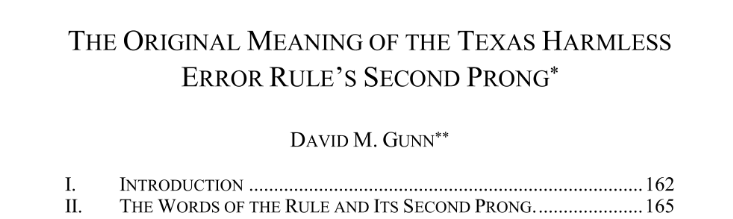
Justice David Gunn recently wrote this interesting article in the South Texas Law Review about the evolution over time of an important part of the harmless erorr rule.
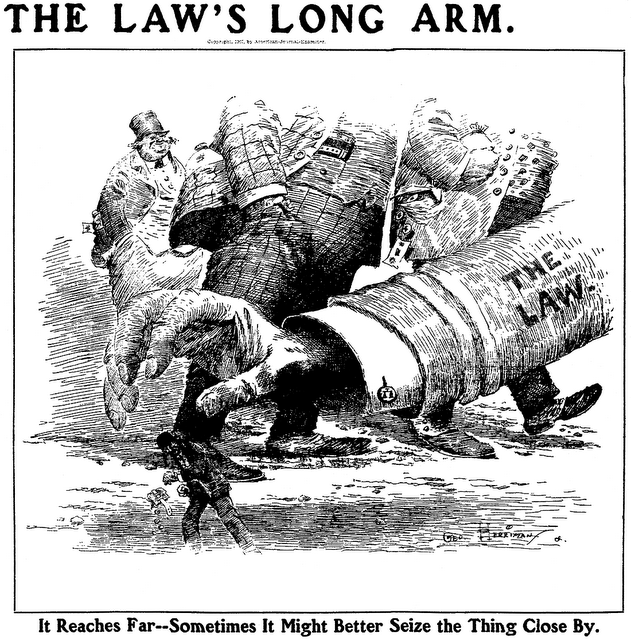
 An out-of-state bus company purposely availed itself of Texas by entering an “Interline Agreement” with Greyhound, but the “operative facts” of the claims did not arise from those contacts. The Fifth Court held that the claims against the bus company were “principally concerned with the driver’s operation of the bus in Utah and [the company’s] conduct in employing the driver and otherwise providing the bus transportation in question,” rather than any activities or agreements that took place in Texas. Western Trails Charters and Tours, LLC v. Provance, No. 05-24-01089-CV (May 29, 2025) (mem. op.). (The graphic was an attempt to show, using AI, the “long arm” statute reaching out to a bus, which did not entirely succeed.)
 Following up on the Orca opinion’s memorable warning about “red flags” and justifiable reliance, in American Midstream v. Rainbow Energy Marketing Corp. the Texas Supreme Court held that “[t]he e courts below impermissibly blue-penciled extra words into … the contract that gave rise to this dispute …” (specifically, reading the contract as if the words “scheduled” and “physical” appeared in a key contract term about deliveries). No. 23-0384 (Tex. May 23, 2024).
In Layla’s Day Spa, Inc. v. HD Salon Group, LLC, the Fifth Court addressed the measure of damages in a business-purchase dispute involving the loss of key employees.
The trial court awarded damages based on gross revenue, using two models: one comparing average annual revenues before and after the loss of technicians, and another dividing average revenue by the number of technicians and multiplying by the number lost.
The Fifth Court reversed, emphasizing that “the calculation of lost-profit damages must be based on net profits, not on gross revenue or gross profits.” No. 05-24-00065-CV, May 21, 2025.
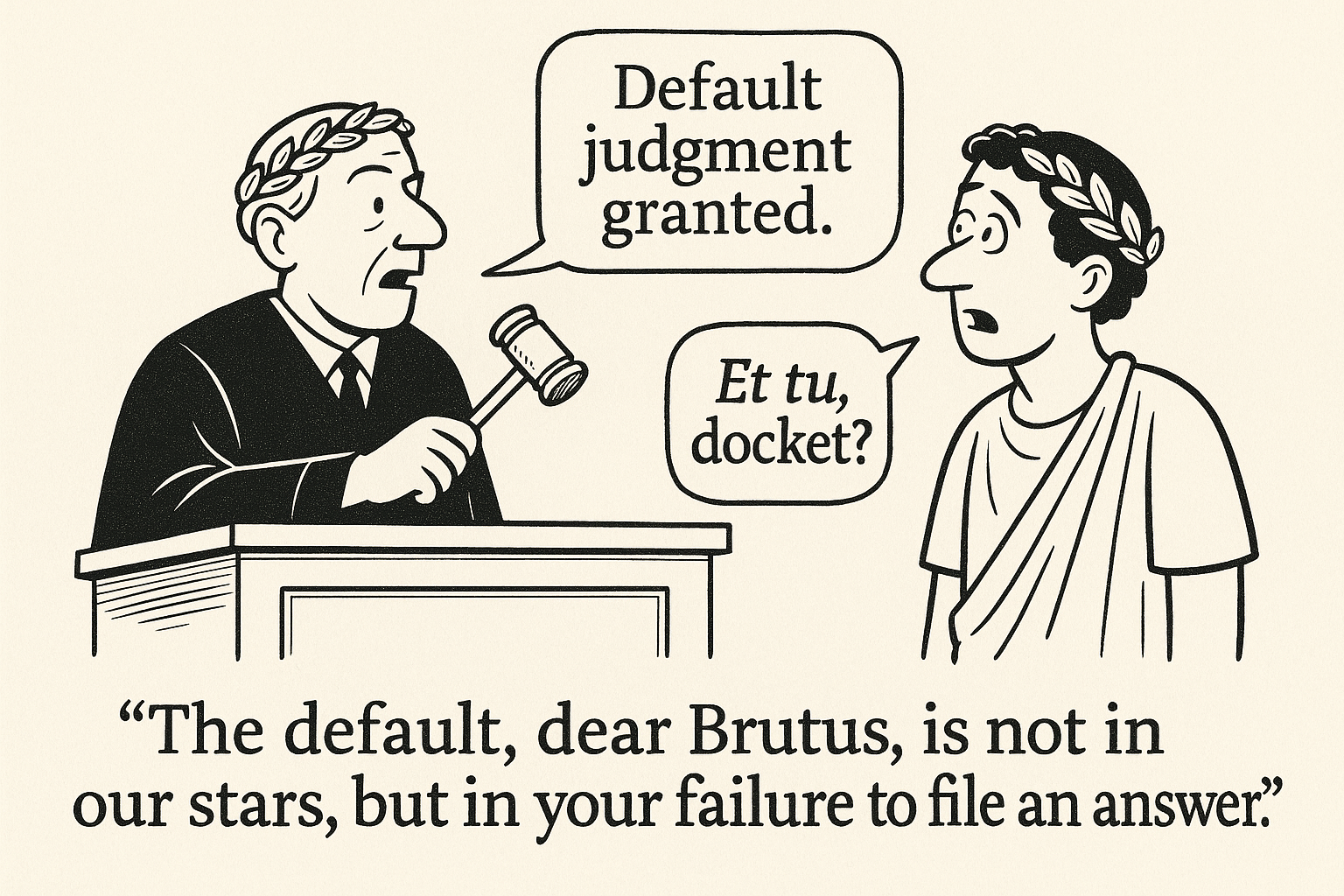 “As to the October 6 answer being filed by Liang, a non-attorney, this Court has explained ‘a non-attorney’s answer on behalf of a corporation is a “curable defect” and does not make the answer ineffective. Although the answer is defective, it is sufficient to prevent the trial court from granting a no-answer default judgment against the corporate defendant.” Deal Finder LLC v. Cruz, 05-24-00311-CV (May 9, 2025).
“The issue in this case is whether a trial court, in ruling on a no-evidence motion for summary judgment, should consider previously filed evidence that is referenced in, but not attached to, a response to the motion. We hold that Texas Rule of Civil Procedure 166a(i) does not require attachment of previously filed summary judgment evidence and that the response at issue here sufficiently pointed out and discussed the evidence in compliance with the procedural rules.” State v. $3,774, No. 24-0258 (Tex. May 17, 2025).
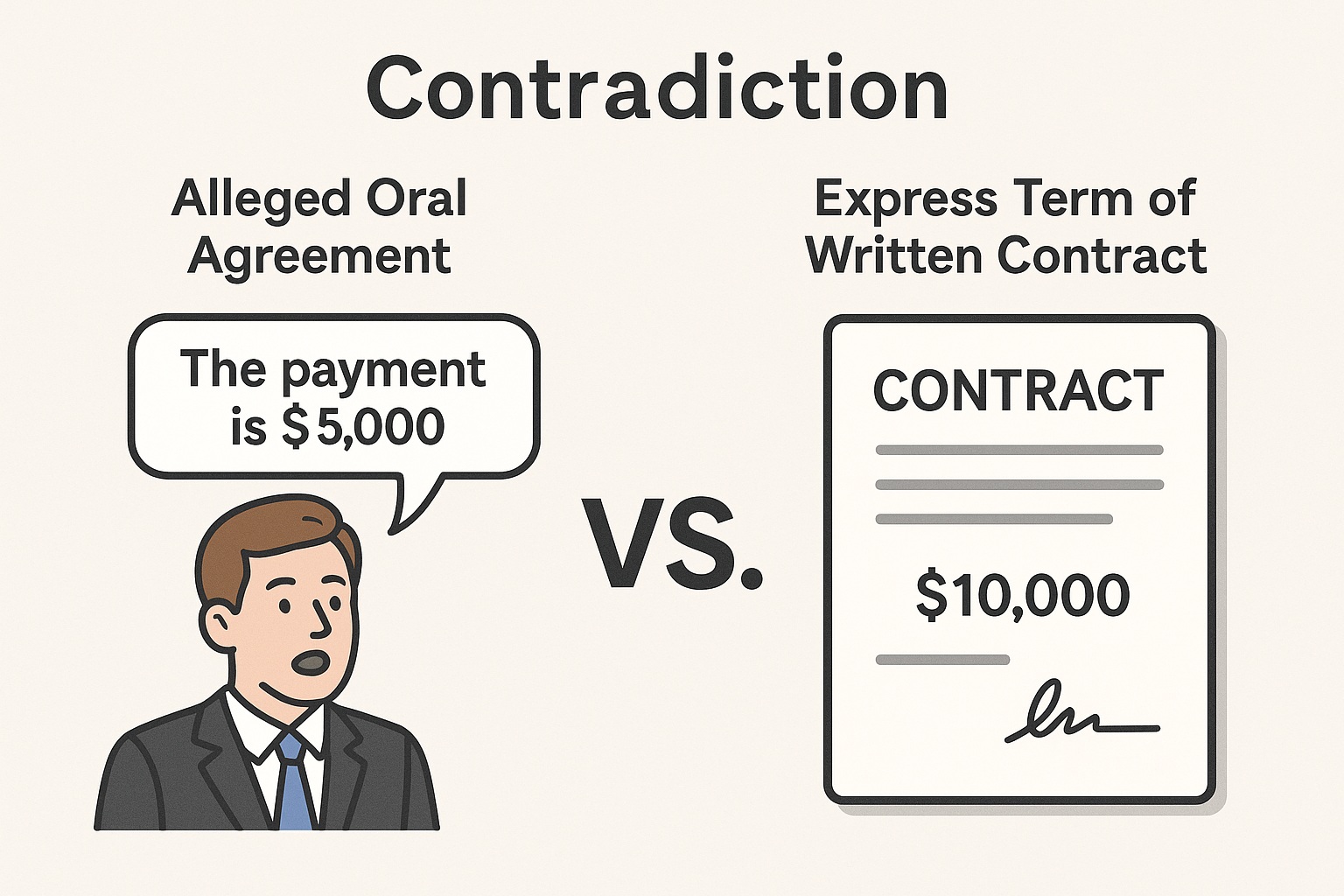 In Roxo Energy, LLC v. Baxsto, LLC, LLC, the Texas Supreme Court addressed (again) the element of justifiable reliance, in the context of alleged oral promises that contradicted written agreements.
Specifically, the Court held that claims based on oral representations about the lessee’s intent to develop the mineral lease, rather than “flip” it, failed ecause the written lease expressly let the lessee transfer its interest with no obligation to drill or develop the land. The Court emphasized that “an unqualified contractual right to transfer a lease contradicts a prior oral promise not to do so,” making reliance on such oral promises unjustifiable.
The Court also rejected claims based on alleged misrepresentations about bonus payments. The only written commitment about bonus payments was a “most favored nations” clause, which was not breached. The Court explained that the absence of any language in the written agreements confirming the alleged oral representations about bonus amounts was itself a “red flag negating justifiable reliance””–“[T]he prudent response is to demand that the parties’ discussions be reflected in the writing—not to sign an agreement that makes no mention of the promises and then try to hold your counterparty to them anyway.”
No. 23-0564, Tex. May 9, 2025.
In Luxottica of Am., Inc. v. Gray, the Court of Appeals addressed the element of justifiable reliance in the context of fraud and related claims arising from the sale of franchise stores.
The Court held that the existence of clear contractual disclaimers and “as-is” provisions in the relevant agreements conclusively negated the element of justifiable reliance, which is required to prove claims for common-law fraud, civil conspiracy, and statutory
fraud. Specifically, the court pointed to language in the franchise and purchase agreements stating that the buyer “did not rely on any incidental statements about success made by [Luxottica], its affiliates or employees” and that the business was being conveyed “AS IS WHERE IS, WITHOUT WARRANTY EXPRESSED OR IMPLIED.” No. 05-23-00020-CV (May 5, 2025) (mem. op.). (LPHS represented the successful appellant in this case.)
I recently moderated a panel at the Fifth Circuit Judicial Conference about AI and the law, and was honored to meet two energetic thinkers in that important and rapidly developing area. You can learn more about them here:
I hope you enjoy their work and follow their thought leadership on the world-changing force of generative AI technology.
In the young days of the Republic, it was generally held that “estoppel could not be asserted against a sovereign.” Block v. North Dakota ex rel. Bd. of University and School Lands, 461 U.S. 273, 297 n.3 (1983) (O’Connor, J., dissenting).
Modern times have brought a more relaxed perspective on that principle, as summarized by the Texas Supreme Court in PDT Holdings, Inc. v. City of Dallas, No. 23-0842 (Tex. May 2, 2025):
Mistaken actions by city officials generally will not equitably estop the city from performing its governmental functions. But we have long recognized that estoppel may be necessary to prevent manifest injustice in exceptional cases where a citizen relies on affirmatively misleading government statements and suffers substantial loss as a result. …
We agree that a mere mistake in issuing a permit is not sufficient for estoppel, but that is not what happened here. Instead, city officials affirmatively told the builder that 36 feet was the applicable height limit, issued an amended permit for that height after inspecting the construction, and stated that the duplex was “OK TO FINISH” even after they identified the ordinance violation. Accordingly, we hold that legally sufficient evidence supports the disputed elements of estoppel, and the trial court did not abuse its discretion in concluding estoppel is necessary to prevent manifest injustice.
No. 23-0842 (Tex. May 2, 2025).
In Exporttek, Inc. v. Vista Bank, the appellant offered these reasons for continuance of a summary-judgment hearing:
• The discovery has not expired.
• The discovery date expires on April 7, 2024.
• The motion for summary judgment addresses complex fact issues about what Defendant[] knew and when[,] which can only be resolved through further discovery.
• Plaintiff[s] intend to serve Defendant with written discovery prior to end of discovery deadline.
• Plaintiffs seek an amendment to the scheduling order to extend the time of the discovery to allow Plaintiffs to take the deposition of Defendant’s officer, Landon Willes[s].
• Specifically, the actions of the bank in the fast changing COVID regulatory climate while fast tracking loans for a “windfall” to clients requires serious investigation as to what Vista Bank was doing and whether they punished []Plaintiff[s] for Vista Bank’s hasty decisions.
The Fifth Court did not accept those reasons:
“These general and conclusory assertions do not satisfy the requirements of Rule 252. At best, Borrowers provided a vague description of the discovery they sought. Further, Borrowers failed to establish the materiality of any proposed discovery. Borrowers’ claims are for breach of contract and the contract at issue contained entire-agreement and no-waiver provisions. Motivations are not germane to the resolution of Borrowers’ breach of contract claims. Moreover, Borrowers did not provide any information regarding the diligence on their part in obtaining discovery prior to the hearing.”
The Court went on to review some unfavorable facts in the record about diligence. No. 05-24-00915-CV (Apr. 24, 2025) (mem. op.).
While the supreme court takes the entire case when it grants review, as a court of discretionary review it has discretion about what specific issues to address in its opinion. An example appears in First Sabrepoint Capital Mgmnt., LP v Farmland Partners Inc., which reversed on an issue about the timeliness of the trial court’s TCPA order, and then addressed a point about collateral estoppel:
While the court of appeals erred by declaring void the trial court’s order granting Sabrepoint’s TCPA motion, it correctly reversed the trial court’s order granting Sabrepoint’s motion for summary judgment based on collateral estoppel. Because collateral estoppel is the basis for the summary judgment motion and a basis for the TCPA motion, the doctrine’s application to this case will be at issue on remand. Accordingly, in the interest of judicial efficiency, we will address its application here.
No. 23-0634 (Tex. Apr. 25, 2025).
Addressing the unfortunate complexity that can arise from the interaction of judgment-finality principles and sanctions motions, the Fifth Court held in Bandas Law Firm, P.C. v. Modjarrad & Assocs., P.C.
“Based on the text of [Tex. R. Civ. P.] 329b(g), the supreme court’s opinion in [Lane Bank Equip. v. Smith Southern Equip., Inc.], and this Court’s applicable precedents construing them, we conclude that a postjudgment motion for sanctions may qualify as a plenary-power-extending rule 329b(g) motion to modify the judgment, but only if the motion for sanctions specifically requests a substantive change in the existing judgment.”
No. 05-23-01115-CV (Apr. 25, 2025) (mem. op.).
 Willowgate Homeowners Ass’n v. Young rejected a HOA’s argument that the “crosshatched area” on a map was sufficient under the Statute of Frauds to describe an alleged common area. Specifically:
No. 05-24-00173-CV, Apr. 21, 2025 (mem. op.).
“The difference between  aming Carlos Whitfield and Donna M. Williams as WWW’s registered agent cannot be characterized as ‘minor.’ The critical distinction, however, is that an incorrectly named agent was not served pursuant to Tex. R. Civ. P. 106(a). Instead, process was served in accordance with the court’s [substituted-service] order under Tex. R. Civ. P. 106(b).” Allied World Nat’l Assurance Co. v. Nisus Corp., No. 05-24-00208-CV (April 16, 2025) (mem. op.).
 A “one-satisfaction” rule required reversal in Dorvil v. Mason, when all roads led to the same $2 million in damages:
It is apparent from record before us, including the pleadings, the evidence admitted at trial and the closing argument of the Masons’ attorney, that the Masons sought to recover as actual damages on each of the causes of action asserted the $2 million dollars they loaned to Agile. The jury awarded the Masons $2 million dollars in actual damages on each of their direct claims against Dorvil, except their negligent misrepresentation claim, for which actual damages were not awarded. In keeping with the trial court’s order granting partial default judgment against Agile, the final judgment awarded the Masons breach of contract damages of $2 million against Agile and, additionally, held Dorvil jointly and severally liable for same. In addition, the judgment awarded the Masons damages of $2 million dollars on their direct claims against Dorvil. As a result, the final judgment in effect awarded the Masons actual damages against Dorvil in the amount of $4 million, resulting in an improper double recovery.
No. 05-23-01020-CV (April 10, 2025) (mem. op.) (emphasis added).
 A recent order from the Fifth Court that a party provide copies of several un-findable opinions suggests that, yet again, someone misused generative AI technology and relied on “hallucinated” case law.
 Two concepts frame the legal-sufficiency issue in Raoger Corp. v. Myers.
First, the Dram Shop Act imposes liability on providers of alcoholic beverages if they serve a customer who is “obviously intoxicated to the extent that he presented a clear danger to himself and others.” The Act requires that the intoxication be “apparent to the provider” when the alcohol was served—a higher tandard than the common-law requirement that the provider “knew or should have known” of the customer’s intoxication.
Second, the rule against “inferences on inferences” prohibits the stacking of conclusions to establish a fact. As Raorger summarized: “Findings must be supported by facts in evidence, not conjecture, and we cannot pile speculation on speculation and inference on inference.”
In Raorger, the plaintiff relied on test results showing that a driver had BAC of .139 approximately 3-4 hours after leaving a restaurant. The supreme court held that while the BAC test results supported an inference that the driver drank a large amount of alcohol, no direct evidence linked that inference to the driver’s appearance and behavior at the restaurant.
More specifically, the Court highlighted that all relevant witnesses testified that the driver did not show signs of obvious intoxication at the restaurant. Speculation about how he “might have” appeared based on his BAC results was insufficient: “Speculative and conclusory testimony, by experts and lay witnesses alike, is incompetent and cannot support or defeat summary judgment.”
Footnote ten of the opinion analyzes the application of this holding to expert analysis more generally. No. 23-0662, April 11, 2025.
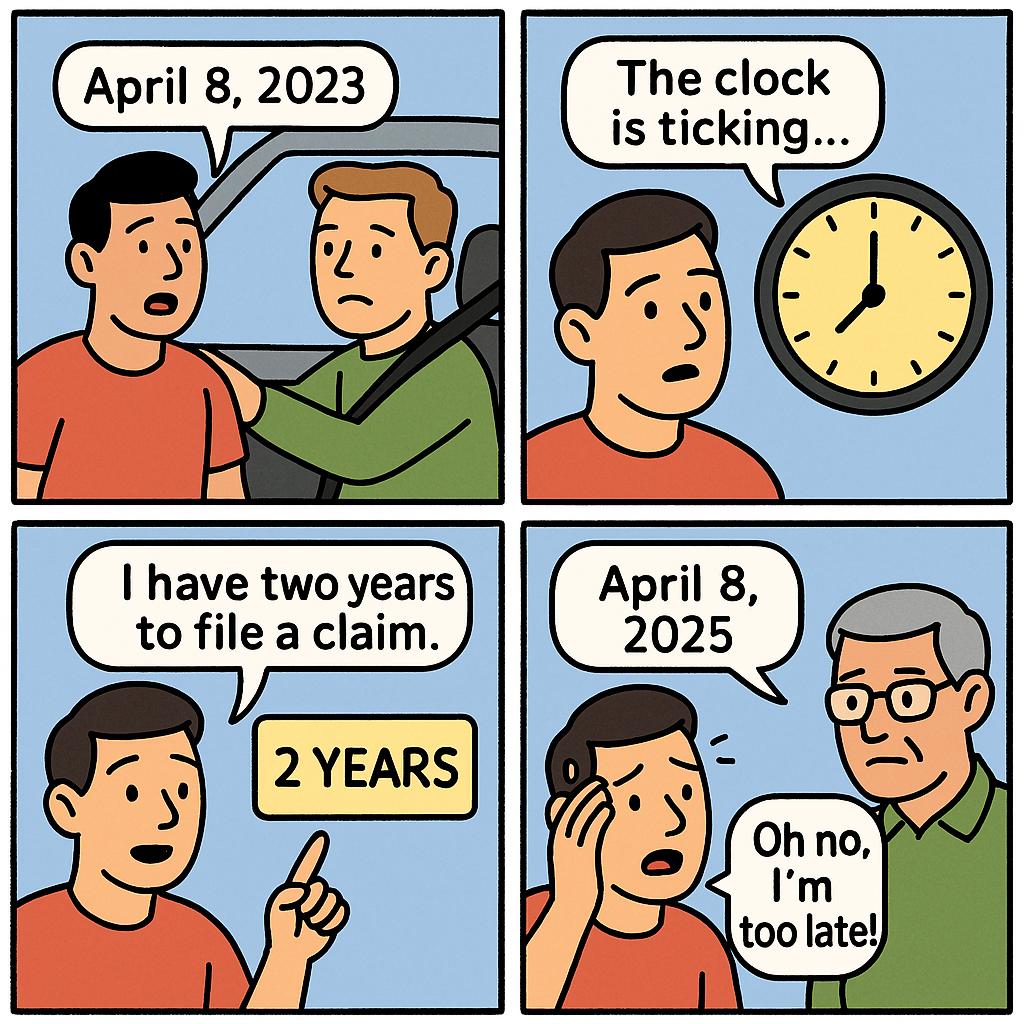 Davis v. Homeowners of Am. addressed the enforceability of a contractual limitations period in an insurance policy.
The Fifth Court held that the policy’s provision requiring suit to be filed within two years and one day from the date the claim is accepted or rejected, or three years and one day from the date of the loss, did not violate Texas Civil Practice and Remedies Code § 16.070(a).
The Court distinguished this case from Spicewood Summit Office Condos Ass’n v. Am. First Lloyds Co. noting that the policy in Davis did not impermissibly shorten the limitations period to less than two years, as the trigger date was based on the claim’s acceptance or rejection rather than the date of loss. No. 05-24-00035-CV, Apr. 7, 2025 (mem. op.).
In Jackson v. Cole, the Fifth Court addressed the mention of insurance during trial, the preservation of that topic as appellate error, and the requirement of harmful error.
The record showed that on cross-examination, a friend of the plaintiffs described what she had been told about the car accident at issue. In doing so, the witness made two references to the exchange of insurance cards. Later, one of the plaintiffs made a similar reference to an insurance card. That testimony drew objection, after which the trial court gave a curative instruction. The plaintiffs won an approximately $300,000 verdict.
Preservation. The Court agreed that the plaintiff’s reference to insurance was improper. But the defense did not object to the curative instruction at the time it was made, and the record also showed that the jury was given then pattern instruction to “not consider or guess whether any party is covered by insurance unless I tell you to.” Error was not preserved, even as to the mention of insurance to which an objection had been made.
Harm. The Court detailed the trial evidence and held that “the mere fact that liability was ‘hotly contested’ due to conflicting testimony in this case, without more, has not demonstrated harm warranting reversal when the record contains evidence supporting the jury’s verdict.” From there, the Court observed that the references appeared to be inadvertent, that the defense had not challenged the sufficiency of the damages evidence on appeal, and that the trial court appeared to have actively supervised the handling of this issue. Thus, no harm was shown. No. 05-23-00424-CV (April 1, 2025) (mem. op.).
 McDonald v. Four Rivers Devel., LLC, discussed yesterday on a procedural point, also addressed the distinction between a condition precedent and a covenant within a contract. The Fifth Court held that a 25% profit margin requirement for commission payments was not a condition precedent but rather a covenant or term of the contract.
It explained, “We do not view the 25% profit margin requirement as a condition precedent that would require a specific denial. The provision – commissions calculated at 6% for any job sold by McDonald in which the overall profit on the job was 25% or more – was the measure of calculating commissions, i.e., a covenant or term of the contract.”
A condition precedent is an event that must occur before a right can accrue to enforce an obligation, while a covenant is an agreement to act or refrain from acting in a certain way. The court emphasized that this did not indicate an “if this, then that” scenario, as typical of a condition precedent. Instead, the 25% profit margin was a term used to calculate commissions, making it a covenant. No. 05-24-00431-CV (March 28, 2025) (mem. op.).
McDonald v. Four Rivers Devel., LLC addressed, inter alia, an issue of trial by consent. The appellant argued that the trial court erred in admitting evidence about a “25% profit margin requirement,” but the Fifth Court noted that the appellant mentioned the 25% profit margin in opening statement and asked about it during direct examination, thereby making the issue relevant–before later objecting to further evidence on the subject. No. No. 05-24-00431-CV (March 28, 2025) (mem. op.). (My partner John Volney and I wrote this article in Headnotes a couple of years ago about then-recent Fifth Court cases on similar trial-by-consent issues.)
 The Dallas division of the Business Court recently addressed contractual modification of partnership duties in Primexx v. Primexx, (March 9, 2025). Consistent with the supreme court’s general theme in Energy Transfer v. Enterprise, 593 S.W.3d 732 (Tex. 2020), that statutory partnership-formation requirements can be modified, Primexx held that a partnership agreement had effectively limited the (nonwaivable statutory) duties of loyalty and care to the fullest extent permitted by Texas law.
Specifically, the Court found that the agreement allowed the controlling partner to act in its sole interest and discretion, provided it met the minimum statutory requirements under the Texas Business Organizations Code. While the agreement limited the fiduciary duties, it did not eliminate the obligation to act in good faith. And the good faith obligation of the TBOC does not rise to the level of a separate fiduciary duty but requires parties to “deal fairly” with each other.
Accordingly, the controlling partner’s actions in exercising its “drag-along” rights and forcing the sale of the partnership’s business were within the bounds of the modified fiduciary duties as outlined in the agreement.
In a flashback to a common area of litigation in 2017-18, Ruff v. Ruff addresses the applicability of the TCPA to claims involving the signing and filing of a deed. The appellant argued that her actions were protected by the TCPA as they were based on her exercise of the right to petition. The Fifth Court saw matters otherwise, concluding: “[T]he events on which Suzann’s claims are factually predicated are Jennifer’s signing and filing the deed, which were not communications in or pertaining to a judicial proceeding.” No. 05-24-00095-CV, Mar. 10, 2025 (mem. op.).
 Kennedy v. NCAA addressed the issue of whether the plaintiffs’ claims about CTE were barred by limitations. The Fifth Court reversed the trial court’s summary judgment in favor of the NCAA, holding that the NCAA did not conclusively establish that defense.
The Court found fact issues as to when the plaintiffs knew, or should have known through the exercise of reasonable diligence, that their father’s injury was likely related to his participation in college football. It considerd several specific events, including: the plaintiffs’ opt-out from a class-action settlement in 2017, an October 2, 2015 email inquiry about CTE, an August 18, 2014 intake questionnaire reporting head trauma from college football, a note by a doctor on October 8, 2015, and a 1998 conversation between the decedent and his brother about cognitive decline potentially related to football. No. 05-23-00958-CV, Mar. 25, 2025 (mem. op.).
The supreme court’s detailed review of a takings issue in Commons of Lake Houston v. City of Houston turned on this basic point:
“[W]e have long rejected ‘the notion that the government’s duty to pay for taking property rights is excused by labeling the taking as an exercise of police powers.’ Indeed, whether a regulation constitutes a valid exercise of the police power—or promotes any other important public policy, purpose, or interest—is simply irrelevant to whether the regulation causes a compensable taking.”
No. 23-0474 (Tex. March 21, 2024) (citations omitted).
MPI Indus. Carolinas, LLC v. CTE Networks LLC reversed the denial of a special appearance, noting that the work performed under the disputed agreement occurred in North Carolina and South Carolina, and that the plaintiffs’ unilateral activities, such as sending invoices from Texas, were irrelevant to the jurisdictional analysis. No. 05-24-00560-CV (March 11, 2025) (mem. op.).
It’s hard to improve on the supreme court’s own summary of how it resolved a jurisdictional dispute involving the new 15th Court of Appeals, so here it is. The consistent theme in these cases has been fidelity to the statutes’ plain meaning.
 To challenge a remand order by the new Business Court, the path to take is a mandamus petition rather than direct appeal, as recently confirmed by In re ETC Field Services LLC, from the 15th Court of Appeals on February 21:
ETC appealed the remand order to this Court. Tema moved to dismiss the appeal on the ground that it was not a final order and no statute authorized an interlocutory appeal.2 ETC defended the interlocutory appeal, but alternatively filed this original proceeding for mandamus relief if interlocutory appeal was unavailable. We hold today that no interlocutory appeal is available in these circumstances. … “But that of course does not preclude mandamus review.” “[T]he Legislature’s decision to forego interlocutory review of all pending cases in no way suggests it intended interlocutory review of none of them.” Accordingly, we turn to that issue in this opinion.
No. 15-24-00131-CV (15th Ct. App.) (citations and footnotes omitted).
 In Elsell v. Encore Wire Corp., the Fifth District reversed a defense summary judgment, finding a genuine issue of material fact about the credibility of the reasons provided for Plaintiff Elsell’s termination. Interestingly, the panel consists of three newly-elected Justices, two of them Republicans. The Court noted two points:
Therefore, “reasonable and fair-minded persons could differ on whether Bouchard’s stated reason for firing Elsell was actually based on an interview of Elsell that was objectively brief, conjectural, and uninformed.” No. 05-23-00588-CV, Mar. 14, 2025 (mem. op.).
 Miles-Edmond v. Skillman Prop. Inv. Dallas LLC addressed “Malooly” issues and the need for appellants to challenge all potential bases for a trial court’s summary judgment ruling.
A general issue that the trial court erred in granting the motion for summary judgment might be sufficient to allow argument on all possible grounds. However, the appellant must then, in fact, substantively attack each basis upon which the summary judgment could have been granted.
Here,”[b]ecause the summary judgment could have been based on these no-evidence grounds, and because Miles-Edmond failed to challenge these grounds, we must affirm the trial court’s summary judgment.” No. 05-23-00789-CV (mem. op.) (Feb. 24, 2025).
 Bone-Martin v. Moss addressed federal copyright preemption in the context of a judgment-collection action. The Fifth Court held that the the trial court lacked jurisdiction to divest the appellants of their federal copyrights and transfer ownership of certain copyrighted videos to the appellees.
The Court emphasized that the Copyright Act grants exclusive jurisdiction to federal courts over matters related to copyright ownership and transfer. Therefore, “the trial court had no jurisdiction to determine the ownership of the videos and whether the purported transfer of videos to Google or another virtual platform was a ‘voluntary transfer’ under the Copyright Act.” No. 05-22-00439-CV (Feb. 13, 2025) (mem. op.).
Vincent v. Deutsche Bank reversed a judgment in a FE&D case when:
The trial court’s June 12 written notice that trial was set for July 14, following the trial court’s instruction to “reset” the case, establishes that the trial court “reset” the case on July 14, but then proceeded to trial on June 15 without notice to Vincent. When a case previously has been set for trial, the trial court “may reset said contested case to a later date on any reasonable notice to the parties or by agreement of the parties.” Tex. R. Civ. P. 245. Here, however, there is nothing in the record to show that that Vincent received “reasonable”—or any—notice of the proceedings on June 15.
No. 05-23-00705-CV (Feb. 20, 2025) (mem. op.).
 The supreme court rejected a claim of an informal fiduciary duty arising from an accountant-client / business relationship in Pitts v. Rivas:
This evidence comes nowhere close to creating a fiduciary relationship under our precedents. There is no evidence that a special relationship of trust and confidence preceded the parties’ business agreement. Rivas’s subjective trust in the Accountants is no evidence of a fiduciary relationship. Providing discounted commercial services— like home-building—to a business associate does not impose fiduciary duties on the recipient. And the evidence offered to show a special personal relationship between Rivas and the Accountants amounts only to business conversations, a few dinners, and a close friendship between their sons.
A four-Justice concurrence, written by Justice Huddle, questioned the validity of the entire concept of an informal fiduciary duty:
In these contexts, heightened legal duties are justified because the fiduciary is empowered—if not to direct, at least to impact—the rights and affairs of others. But the same is not true in the context of so-called “informal” fiduciary relationships. The construct is flawed because the so-called “informal” fiduciary wields no legal authority to direct another’s affairs that could justify a corresponding heightened fiduciary duty. The Court’s refusal to find that an informal fiduciary duty arose in any case in almost fifty years, despite the theory’s frequent invocation, proves it is time to disavow the notion that “certain informal relationships may give rise to a fiduciary duty.”
No. 23-0427 (Tex. Feb. 21, 2025).
In re Ruff found that an order was too vague to enforce by contempt. The order involved discovery obligations and the relevant paragraph was as follows:
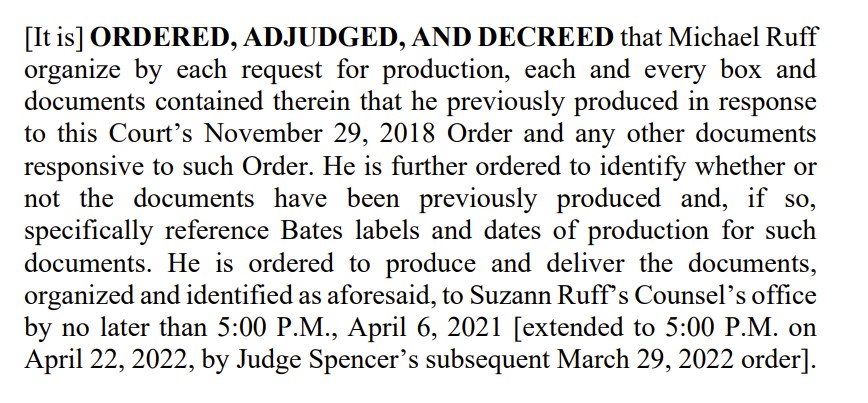
The Fifth Court held: “[R]reasonable people could come to different conclusions as to what relator was supposed to do in order to comply with this provision of the March 23, 2021 order. Consequently, that provision is too unclear to support a judgment of contempt.” Specifically:
The case of Totus Group LLC v. Pruitt Family Living Trust provides a “Restatement of TRCP 683” for the Fifth Court’s precedent, reversing a temporary injunction for failing to comply with that rule in many ways, including:
No. 05-23-01222-CV (Feb. 14, 2025) (mem. op.).
 Texas law favors arbitration agreements – but even the most favorable view of the topic requires an agreement. In Exencial Wealth Advisors, LLC v. Sipes, the relevant contract required a signature to become effective, and the record did not contain a signed copy of that instrument. Therefore, the contract failed for lack mutual assent, and arbitration of the parties’ dispute was not required. No. 05-24-00964-CV (Jan. 31, 2025) (mem. op.).
The Fifth Court affirmed the temporary injunction against the Dallas short-term rental ordinances, stating:
The Texas Constitution provides: “No citizen of this State shall be deprived of life, liberty, property, privileges or immunities, or in any manner disfranchised, except by the due course of law of the land.” TEX. CONST. art. I, § 19. Appellees have “a vested right to lease their properties and this right is sufficient to support a viable due-course-of law claim.” City of Grapevine, 651 S.W.3d at 347. Under the circumstances, we conclude appellees proved their probable right of recovery under their due-course-of-law argument because they alleged they possessed wellestablished rights to lease their property and presented evidence tending to show that the City would deny them those rights by enforcing the two ordinances at issue.
City of Dallas v. DSTRA, No. 05-23-01309-CV (Feb. 7, 2025) (mem. op.). LPHS represents the Appellees in this litigation.
 In Expo Group v. Purdy, the Fifth Court addressed whether the temporary injunction and related bond satisfied Rule 684, which requires that the trial court “fix the amount of security to be given by the applicant,” i.e., set a bond. Because the temporary injunction order did not set a specific bond amount, the order was void from inception.
The Court further clarified that the cash already deposited into the court’s registry for a different purpose could not be used to satisfy the bond requirement under Rule 684. It referenced the supreme court’s opinion in Ex parte Lesher, which held that the intent of Rule 684 is to require a bond payable to the party against whom the injunction is issued before the order may lawfully issue. No. 05-24-00653-CV, Jan. 27, 2025 (mem. op.)
My friend Arturo Ayala at CSBA recently wrote this useful article about what happens to a supersedeas bond when the appeal ends.
Expo Group v. Purdy clarifies a point about the statutory grant of jurisdiction over injunction orders: “[M]odifying a temporary injunction is akin to granting a temporary injunction—it creates a new or amended temporary injunction from which a party may appeal; refusing to modify does not.” No. 05-24-00653-CV (Jan. 27, 2025) (mem. op.) (citation omitted).
 While much less visible than it once was, the TCPA continues to have impact in an appropriate case. For example, in High Risk Pregnancy doctors, PLLC v. Akhmedjanova, the Fifth Court addressed whether the plaintiff, Akhmedjanova, had established a prima facie case for her claims, after concluding that the TCPA applied to the defendants’ exercise of their right of petition.
The Court ruled against her on each such claim; for example, on her claim for invasion of privacy, the Court noted that Akhmedjanova’s complaint centered on the publication of her past physician-patient relationship, but she did not show that the defendants intruded or pried into her private affairs. No. 05-24-00413-CV, Jan. 15, 2025 (mem. op.).
 In Santander Consumer USA Inc. v. Enterprise Fin. Group, Inc., the Fifth Court addressed preservation of charge error.
Specifically, the Court held that the appellant failed to object specifically to the broad form submission of Question No. 1, which asked if the appellant failed to comply with the agreement. It observed that the appellant “did not object to the submission of Question No. 1 at the charge conference or before the charge was read to the jury,” and reminded that submitting a proposed charge or jury questions pretrial is not enough to preserve a charge-error issue.
Importantly, this analysis means that “[t]he use of a global denial of objections and requests based solely on the parties’ pretrial submission of proposed jury charges does not preserve issues of charge error for appellate review.” No. 23-0770-CV (Dec. 31, 2024) (mem. op.).
Dallas Police & Fire Pension System v. Townsend Holdings, LLC illustrates the practical problems about objecting to allegedly improper argument–objection risks highlighting the problem, while waiting risks a waiver finding:
DPFP chose not to raise its concerns until after the jury began deliberations. DPFP’s chosen strategy risked that any error would be unpreserved if improper arguments were curable. DPFP had significant time during the five weeks of trial to consider objections and request curative action. If DPFP were concerned about provoking the ire of the jury, it could have requested admonitions outside the presence of the jury to rein in overzealous attorneys. To preserve error, DPFP should have timely objected and sought appropriate instructions from the trial court, who was in the best position to fashion the appropriate remedy.
No. 05-23-00099-CV (Dec. 17, 2024) (mem. op.).
Also in Santander Consumer USA Inc. v. Enterprise Fin. Group, Inc., discussed yesterday about charge error, the Fifth Court addressed a preservation issue about evidence that the appellant said related to unpleaded theories of contract breach. The Court found that issue was not preserved by a series of objections to relevance, generally, that didn’t refer to the particular contract issue, or by a tender of exhibits as “rebuttal” to the objected-to-evidence:
“[T]he objection made by SCUSA’s Counsel did not mention Section 17.6 and did not articulate that SCUSA objected to EFG asserting unpleaded theories of breach. This objection was insufficient to put the trial court on notice of the actual objection and, therefore, did not preserve error.”
No. 23-00770 (Dec. 31, 2024) (mem. op.).
Governor Abbott has made two appointments for the Texas Supreme Court after the recent retirement of Nathan Hecht–long serving Justice Blacklock becomes Chief, and the Governor’s general counsel becomes the newest Justice.

 The parties’ lease in Lamar Advantage Outdoor Co. v. LaCore Enterprises, LLC contained this provision, which the Fifth Court held to create a right of first refusal (as opposed to a purchase option):
If LESSOR desires to sell or otherwise transfer any Interest in the property upon which the sign is situated, LESSOR grants LESSEE an option to purchase a perpetual easement (servitude) encompassing the sign and the access, utility service and visibility rights set forth herein. LESSEE must elect to exercise this option within thirty (30) days after written notification of LESSOR’s desire to sell. LESSEE’S failure to exercise this option within said period shall be a waiver of this option. …
Following an earlier Fifth Court case about a similar clause, the Court held that because this provisision was not “limit[ed to] the right of first refusal to the first sale or transfer of the Property or contemplating waiver of the right if not utilized in conjunction with prior transactions.” No. 05-23-00210-CV (Dec. 31, 2024) (mem. op.).
In Wal-Mart Stores, Inc. v. Xerox State & Local Solutions, Inc., on remand from the Texas Supreme Court, the Fifth Court concluded that various tort claims were precluded by the economic-loss rule in the context of the particular industry involved:
It is inappropriate for the courts of Texas to disrupt the system of agreements of the different states with Xerox for protection of those states’ retailers. Nor is it appropriate for Texas’s courts to provide common-law protection for Wal-Mart when the statutes, regulations, and contracts governing the SNAP EBT program failed to do so. We conclude the economic loss rule precludes our finding Xerox had a general common-law duty to prevent Wal-Mart’s losses from the store-andforward transactions subject to Xerox’s second motion for summary judgment.
No. 05-18-01421-CV (Dec. 12, 2024) (mem. op.). LPHS represented Xerox in this appeal.
Estrada v. Boss Exotics, LLC reverses a default judgment, despite finding conscious indifference, because the alleged unliquidated damages were not supported by competent evidence: “On this record, we conclude that appellees’ counsel’s unsworn statement indicating that the balance due on the vehicle was $75,000 does not constitute evidence.”
A dissent questioned whether the majority’s conclusion about conscious indifference is consistent with an extensive line of cases from the Texas Supreme Court about the need to resolve cases on the merits. No. 05-23-00990-CV (Dec. 18, 2024).
 Janus (right) was the Roman god of dualities. Pruitt Family Living Trust v. Totus Gift Card Mgmnt also involved a duality, in the form of evidence and substantive rulings that were not consistent:
Through these inconsistent rulings, the trial court excluded the same evidence it presumably considered when granting TGCM’s special appearance. A trial court cannot allow one party the benefit of using authenticated evidence to support a special appearance while striking the same authenticated evidence to the detriment of the other side. Because of the trial court’s misapplication of rule 120a(3), it stripped appellants of their ability to admit any evidence challenging the special appearance. Stated differently, by striking the evidence relied on by TGCM to support their special appearance, the trial court was left with no evidence upon which it could rule, let alone grant, the special appearance. Accordingly, the trial court abused its discretion by ruling arbitrarily and without reference to any guiding rules
or legal principles.
No. 05-24-00612-CV (Dec. 27, 2024) (mem. op.).
In City of Austin v. Powell, the supreme court overhauls the general framework for resolution of a plea to the jurisdiction based on immunity, observing:
More than twenty years ago, we described the process for resolving a plea to the jurisdiction asserting immunity from suit as one that “generally mirrors that of a summary judgment.” Tex. Dep’t of Parks & Wildlife v. Miranda, 133 S.W.3d 217, 228 (Tex. 2004). We reaffirm this description but acknowledge that dispositive-pleading practice has evolved in the interim. The conceptual similarity largely reflects that the parties’ burdens will depend on the nature of the plaintiff’s claim and how the government poses its jurisdictional challenge. Just as the Texas rules now include not only traditional summary judgment but also no-evidence summary judgment and dismissal under Rule 91a, for example, pleas to the jurisdiction may involve competing evidence, the denial of any probative evidence, or the assertion that the law compels a result regardless of the evidence.
No. 22-0662 (Dec. 31, 2024). Powell does not materially revise the actual framework, but carefully reviews a number of common quotes about that framework to be sure they are consistent with modern-day procedure.
 2025 brings significant change to the Fifth Court, with J.J. Koch becoming Chief Justice, and Mike Lee, Jessica Lewis, Tina Clinton, Earl Jackson, Cynthia Barbare, and Gino Rossini joining as new Justices.
 In Herrera v. Mata, the Texas Supreme Court addressed alternative pleading, particularly in the context of a party’s conditional acceptance of the opposing side’s position, to make a claim based on that position.
Specifically, homeowners argued that certain disputed charges were taxes that should be removed from the tax rolls under the Tax Code’s twenty-year limitations period. They also presented alternative claims under the Water Code, acknowledging the irrigation district’s authority to levy assessments.
The Court emphasized that recognizing the district’s position in the Water Code claim did not mean conceding its validity: “[The homeowners’ recognition of the District’s position is not a concession that the position has merit; it is plain from the pleadings that the homeowners disagree with the District’s characterization.” And the Court noted generally that this result aligns with Texas Rule of Civil Procedure 48, which allows alternative pleadings. No. 23-0457 (Tex. Dec. 6, 2024).
 In In re Euless Pizza, the Texas Supreme Court held that a trial court abused its discretion by denying the defendants’ request to withdraw and amend their initial responses to requests for admission.
The defendants initially admitted that the driver involved in the accident was acting within the scope of his employment, but later sought to amend these admissions based on new information obtained through further investigation. The supreme court held that the defendants showed good cause, as their initial responses were based on a misunderstanding and incomplete information, and a lack of undue prejudice, in that discovery was still ongoing and the trial had not yet been rescheduled.
This opinion is part of a broader pattern of short, per curiam opinions from the supreme court that stress the importance of reaching the merits of cases. And it’s important as a straightforward example of the general two-part test for discovery supplementation in Texas state courts. No. 23-0830 (Tex. Dec. 6, 2024).
 In Baylor Scott & White v. Bostick, the Fifth Court reversed the trial court’s judgment due to errors in the jury charge regarding the definition of an invitee. The Court found that the trial court improperly included the “public invitee” component in the definition of an invitee, which is not recognized under Texas law. The correct definition, as established by the Texas Supreme Court, is that an invitee is “one who enters the property of another with the owner’s knowledge and for the mutual benefit of both,” with the requisite mutual benefit being a shared business or economic interest.
The Court went on to hold that the error in the jury charge was harmful because it related to a contested and critical issue—the plaintiff’s status as an invitee. The evidence was sharply conflicting on this point, and the improper definition let the jury find Bostick was an invitee based on the fact that he entered the hospital as a member of the public. No. 05-23-00606-CV, Dec. 6, 2024 (mem. op.).
 In In re Turtle Creek North Condo Mgmnt Assoc., the Fifth District addressed the issue of designating responsible third parties (RTPs) in a lawsuit concerning water damage in a condominium unit. The court found that the trial judge abused his discretion by denying the relators’ motion to designate RTPs.
The relators moved to designate sixteen other condominium residents and three contractors as RTPs, arguing that these parties contributed to the water damage. Specifically, that the contractors did negligent work on the refrigerator water line connection, and that the residents owned units adjacent to the plaintiff’s and breached their duties to mitigate water intrusion originating in their respective units.
The Fifth Court held that the relators’ allegations were sufficient to meet the fair-notice standard. It also rejected an objection that the relators had not produced evidence to support the RTPs’ inclusion, clarifying that such an evidence-based challenge is premature at the motion-for-leave-to-designate stage.No. 05-24-00990-CV, Nov. 27, 2024 (mem. op.).
 In Texas Right to Life v. Van Stean, the Texas Supreme Court reversed a lower-court ruling that the TCPA did not apply to a particular case, remanding for consideration of the threshold issue of subject matter jurisdiction (here, the plaintiffs’ standing). Two notes:
The Texas Supreme Court recently gave final approval to several changes in the Rules of Appellate Procedure, all of which require the (helpful!) step of bookmarking the various components of an appellate submission.

In In re Schrandt, the Fifth Court addressed the petitioner’s entitlement to advancement of legal fees under company bylaws. The Court agreed with the petitioner’s position, concluding that the bylaws did not condition entitlement to advancement on whether a party did or did not initiate a suit, or even on whether a suit was pending at all. It also found that mandamus relief was proper for a fee-advancement claim under Fifth Court precedent. No. 05-24-01041-CV, Nov. 22, 2024 (mem .op.). LPHS represented the successful petitioner.
Tex. R. Civ. P. 176 and 205 set out a detailed process for obtaining discovery from a nonparty; after review of a record involving notices, subpoenas, and motions to quash, the Fifth Court granted mandamus relief, holding: “Respondent abused her discretion by ordering discovery from nonparties without hearing their motions for protective orders regarding the subpoenas served on February 28, 2024.” In re Creuzot, No. 05-24-00450-CV (Nov. 14, 2024) (mem. op.).
Mandamus issued in a failure-to-rule case when: “Megatel filed its motion to compel arbitration on June 30, 2022, and the motion was initially set for hearing two years ago on November 2, 2022. For various reasons and despite three hearings, two additional settings, and multiple requests, the trial judge failed to rule on the motion to compel arbitration and instead set a jury trial date.” In re Megatel, No. 05-24-01161-CV (Nov. 18, 2024).
 Rockwall County is on the edge of the rapidly expanding Dallas-Fort Worth metropolitan area. That surging growth inevitably brings friction, such asCity of McLendon-Chisholm v. City of Heath, in which one Rockwall city sued the other, and the Fifth Court held that the City of Heath had standing to challenge its neighbor’s land-use decision.
Specifically, the Court found that Heath had demonstrated concrete and particularized injuries, including a projected 358% increase in traffic and a significant decrease in property values, which would negatively impact Heath’s tax base and public services. These injuries were enough for standing because they were distinct from general public injuries and directly traceable to McLendon-Chisholm’s actions.
The Court also held that Heath had standing to bring claims under the Texas Open Meetings Act, noting that TOMA ‘broadly confers standing on any person who shares an injury in common with the general public,” and that Heath alleged specific TOMA violations that directly affected it in a way different from the general public—including the adoption of the challenged land-use actions. No. 05-23-00881-CV, Nov. 8, 2024.
As further detailed in today’s Texas Lawbook, Republicans did not completely sweep the eight races for positions on the Fifth Court. Mail-in and provisional ballots moved Hon. Tina Clinton into a lead over her Republican opponent.
 Dallas Palms LLC v. Jones involved claims that were dismissed because of a failure to provide a certificate of merit, when the movant did not establish that he was, in fact, a licensed architect. The statement of facts describes the various proof deficiencies, which could likely have been avoided with a straightfoward affidavit on the subject. No. 05-23-00156-CV (Nov. 8, 2024) (mem .op.).
 In addition to resolving a thorny question about a legislative subpoena’s interaction with a death sentence, In re Texas House of Representatives reminded of this fundamental point:
With competing claims from (and in some instances within) the three branches of government, it falls to this Court to resolve as a matter of law which branch’s authority must prevail in this situation. In properly adjudicated cases, “[t]he final authority to determine adherence to the Constitution resides with the Judiciary.”
No. 24-0884 (Tex. Nov. 15, 2024).
 Last Friday I received the inaugural “Lawyer’s Lawyer” award from the Dallas Bar Association, described by President Bill Mateja as a lawyer who “eats, breathes, and sleeps law” in comment and public thought about it. (Next to me is Courtney Marcus, filling in for Glenn West, who also received it.) Many thanks to Bill and the DBA, and to readers of this blog: longtime or new; enthusiastic or not!
Republican candidates swept the eight races for positions on the Fifth Court; the Texas Lawbook has a good summary.
An arbitration provision was not illusory when:
“[T]he arbitration provisions apply equally to all parties. The arbitration provisions cannot be amended or terminated unilaterally by the LPs—that would require the approval of partners owning the requisite supermajority of capital interests under the partnership agreements. As previously discussed, amendments to partnership agreements may be duly adopted in accordance with the terms of the partnership agreement to which the limited partner initially agreed.”
Caprocq Core Real Estate Fund, LP v. Essa K. Alley Revocable Trust No. 2, No. 05-22-01021-CV (Oct. 25, 2024) (mem. op.).
 Hyde v. GACP Fin. Co., LLC reversed a $1.7 million judgment because of a pleading-amendment problem. The Fifth Court found that the trial court erred by allowing GACP to amend its petition during trial, to argue for the first time that it sought damages as an agent on behalf of another entity, rather than its own damages. The Court said: “Fair notice is not notice to dig deeper to determine the parties’ claims and damages,” and detailed why GACP’s second amended petition did not give adequate notice of the agency relationship it later claimed.
As a fallback, GACP argued that this challenge failed for lack of a special exception or a verified denial. The Court held that appellants were justified in relying on the second amended petition (which didn’t assert agency), and that the appellants had no reason to file a verified denial about capacity when the relevant agency claim wasn’t in the pleading in the first place. The Court concluded that the appellants timely raised the capacity issue as soon as it became apparent at trial. No. 05-23-00873-CV, Oct. 24, 2024 (mem. op.).
 Despite adequate service, a default judgment nevertheless failed to withstand a restricted appeal when the pleaded cause of action didn’t match the judgment:
The Agreement as described by Struge conflicts with the terms of the Agreement attached to the petition. Because none of the alleged breaches, taken as true, actually constitute breaches of the Agreement under its plain terms, Struge’s pleadings fail to state a valid breach of contract claim and the petition cannot support a default judgment on the grounds of breach of contract.
Albanian-American Cultural Center, Inc. v. Struge Cultural Center, Inc., No. 05-23-01134-CV (Oct. 15, 2024) (mem. op.) Incidentally, the Albanian-American Cultural Center appears to be a thriving celebration of Albanian culture in the Dallas area, which I was unaware of but am certainly happy to see.
The dispute about the execution of Robert Roberson reached the Texas Supreme Court late last week, producing a stay order until lower courts can evaluate the merits of the Legislature’s last-minute subpoena to Mr. Roberson. A concurrence, joined by three Justices, mused about the separation-of-power questions at issue. Despite the obvious merits of Mr. Roberson’s case, one does wonder what future mischief may be enabled by encouragement of assertive exercise of the Legislature’s subpoena power.
The Fifth Court of Appeals has open staff attorney positions. If you or someone you might recommend for employment is interested is pursuing such an opportunity, please click the link for additional information – Full-Time Central Staff Attorney
 Combs v. Crepeau involved a substantial judgment on a fiduciary-duty claim. The Fifth Court found legally insufficient damages evidence, holding as to past damages:
… there is no evidence of the value of the estate absent Michael’s fraud or breaches of fiduciary duty and no evidence from which a reasonable jury could find Diane and Lari’s combined one-half share of the estate was valued at $1,300,000.
That straightforward, high-level holding is supported by a painstaking review of many discrete components of that award. This case, and the damages arguments advanced in it, warrants study by anyone involved in document-intensive litigation about closely-held companies and family finances. No. 05-23-00088-CV (Oct. 7, 2024) (mem. op.).
In Gore v. Trans Union LLC, the Fifth Court addressed whether the Fair Credit Reporting Act preempts Texas statutes about the award of attorney’s fees to a prevailing defendant in a credit-reporting dispute.
The Court rejected this argument, noting that the FCRA does not expressly preempt the attorney’s fees provision in TBCC Section 20.08(c). The court emphasized that the FCRA’s preemption provisions “have a narrow and targeted scope,” and Sections 1681n(c) and 1681o(b) of the FCRA, which govern attorney’s fees, are not among the provisions intended to preempt state law. No conflict arises: “That TBCC Section 20.08(c) allows attorney’s fees for the prevailing party in the absence of a finding of bad faith or harassment by the opposing party does not create an impossibility for compliance or stand as an obstacle to accomplishing Congress’s purposes in enacting the FCRA.” No. 05-23-00659-CV, Oct. 9, 2024.
 In In re Peters, the Texas Supreme Court addressed an assertion of the Fifth Amendment privilege against self-incrimination in the context of civil discovery—an uncommon but critically important Constitutional limit on discovery. The case arose from a tort lawsuit against a defendant who was allegedly driving while intoxicated. Among other holdings, the Court said:
No. 23-0611 (Tex. Oct. 4, 2024).
As part of a broader arc of cases in which the Texas Supreme Court has reversed lower-court rulings that it sees as overly technical, that Court reversed the Fifth Court in Verhalen v. Akhtar, concluding:
When a litigant demonstrates good cause to file a late response to a motion for summary judgment, the trial court must allow the filing. Johnston did not raise this argument in her briefing. We hold that when, as here, a litigant shares the response with the opposing party one day after the response deadline, files an affidavit explaining that the late filing was the result of a mere mistake, and no prejudice will result to the opposing party, the denial of that motion is an abuse of discretion.
No. 23-0885 (Tex. Oct. 4, 2024).
If you enjoyed my article in the Cornell Law Review Online earlier this year about the party-presentation principle, hopefully you will also enjoy a new article of mine in the Texas Law Review Online. Examining cases from the 2023-24 Supreme Court term, it considers whether “originalism” and modern economic theory can comfortably coexist.
 Last week, the supreme court denied mandamus review, of the Fifteenth Court’s denial of emergency relief, in the Attorney General’s lawsuit against the firearms ban of the State Fair of Texas. A concurring opinion noted some oddities in the Attorney General’s litigation position, including:
No. 24-0813 (Sept. 26, 2024).
In in re Mescioglu, the Fifth Court denied a mandamus petition because it: (1) it lacked a proper Tex. R. App. P. 52.3(j) certification stating that every factual statement in the petition was supported by competent evidence; (2) omitted or mismatched relevant exhibits admitted into evidence at the hearing; and (3) failed to include every document that was material to the petitioner’s claim for relief and that was filed in the underlying proceeding. No. 05-24-01096-CV (Sep. 27, 2024) (mem. op.).
 In Conexiones Tornado S. de Rl. de CV, the Fifth Court reversed the denial of a special appearance, made by a Mexican bus company sued for negligence after a bus crash in Mexico. A key issue presented was whether, on this record, the U.S. Supreme Court’s recent opinion in Ford Motor Co. v. Montana Eighth Judicial District Court required reconsideration of the Texas Supreme Court’s focus on the “operative facts” of a case as part of the inquiry about specific jurisdiction.
Legally, the Court held that the supreme court’s “‘“substantial connection’ test was not abrogated by Ford Motor,” and factually, the Court found that Ford Motor was distinguishable, noting: “Unlike Ford, Conexiones has not conceded purposeful availment in Texas. Conexiones argues not only that it lacks Texas contacts, but also that it has structured its business in such a way as to avoid subjecting itself to personal jurisdiction here.” No. 05-23-00353-CV (Sept. 23, 2024) (mem. op.).
In Virtuolotry LLC v. Westwood Motorcars LLC, among other holdings, the Fifth Court reversed a judgment that awarded actual and exemplary damages to a tenant who claimed to have been constructively evicted by the landlord’s owner. The damages were assessed against the owner, individually. The Court noted that the tenant was actually evicted as a result of an FED case, and thus held that “[i]f an actual eviction occurs, there can be no constructive eviction.” In this regard, the Court also noted the distinction between constructive eviction and wrongful eviction claims. No. 05-19-01055-CV (Sept. 17, 2024) (mem. op.). LPHS represented Virtuolotry in the case.
 Zurich Am. Ins. Co. v. MB2 Dental Solutions, LLC declined to take a permissive appeal, stating:
Regarding [Tex. Civ. Prac. & Rem. Code] section 51.014(d)’s second requirement, generally, a trial court will make a finding that an appeal will facilitate final resolution of the case “when resolution of the legal question dramatically affects recovery in a lawsuit.” Conversely, when other issues are left pending in the litigation, ultimate termination of the litigation is not advanced by allowing immediate appeal of an otherwise interlocutory order.
No. 05-24-00288-CV (Sept. 20, 2024) (mem. op.).
 In re Dallas HERO grants mandamus relief in a dispute about amendments to the Dallas city charter. The supreme court held that the City’s additions to an election ballot about proposed amendments failed to satisfy the necessary standards for clarity and definiteness, stating:
… the propositions contradict each other, and the ballot language as a whole will confuse and mislead voters because it does not acknowledge these contradictions or address the effect of the primacy provisions, which are chief features central to the character and purpose of the council-initiated propositions. Because the citizen-initiated propositions must appear on the ballot and the parties have agreed to the ballot language for those propositions, we conclude the proper remedy is to direct the city council not to include its duplicative propositions on the ballot.
No. 24-0678 (Tex. Sept. 11, 2024).